



What Is Optimism? OP Mainnet vs OP Stack
Optimism can refer to an ecosystem, OP Mainnet, or the OP Stack used to build Rollups. This guide separates those terms and explains bridge timing and current frontend risks.

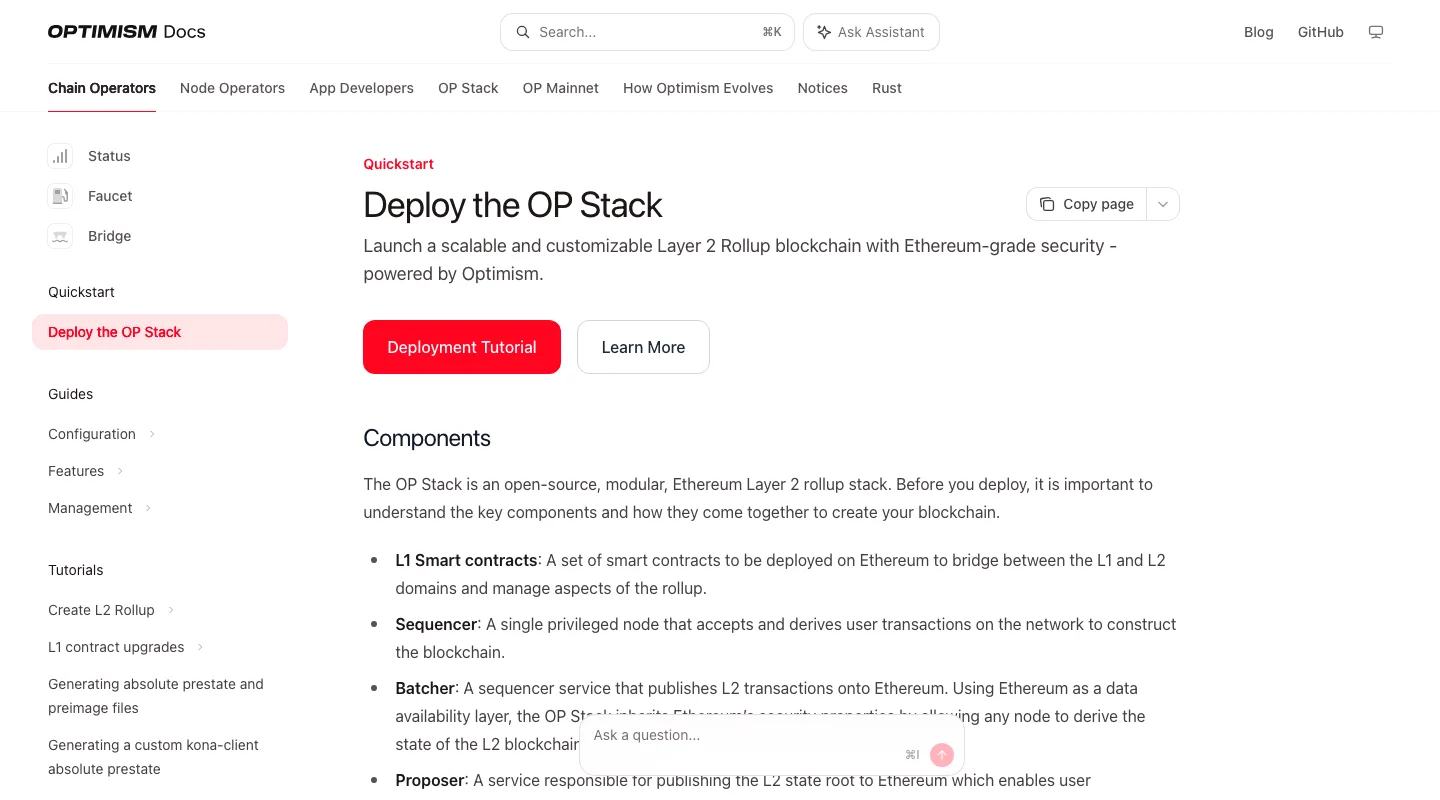
“Optimism” can refer to a project and ecosystem, the OP Mainnet network, or the OP Stack software used to build Rollups. Separating those concepts prevents a common mistake: assuming every chain built with the same stack is the same network.
Short verdict: If you only want to use an app on OP Mainnet, focus on the network, token, bridge, and withdrawal path. The broader OP Stack and Superchain concepts become relevant when comparing multiple chains built with related technology.
The current Optimism documentation homepage emphasizes deploying the OP Stack. Checked on 18 July 2026.
OP Mainnet, OP Stack, and Superchain
- OP Mainnet is the original OP Stack network where users can transact and use applications.
- OP Stack is the modular, open-source software stack used to build Layer 2 Rollups.
- Superchain describes an ecosystem direction in which multiple OP Stack chains adopt shared standards and interoperability.
These labels are related but not interchangeable. Switching a wallet to OP Mainnet does not connect it to every Superchain network. Two chains using OP Stack can still have separate Chain IDs, token contracts, operators, and application risks.
Standard bridge timing
Optimism’s official Standard Bridge documentation states that deposits from Ethereum to OP Mainnet are generally completed in about one to three minutes. Standard withdrawals from OP Mainnet to Ethereum take about seven days because of the withdrawal challenge period.
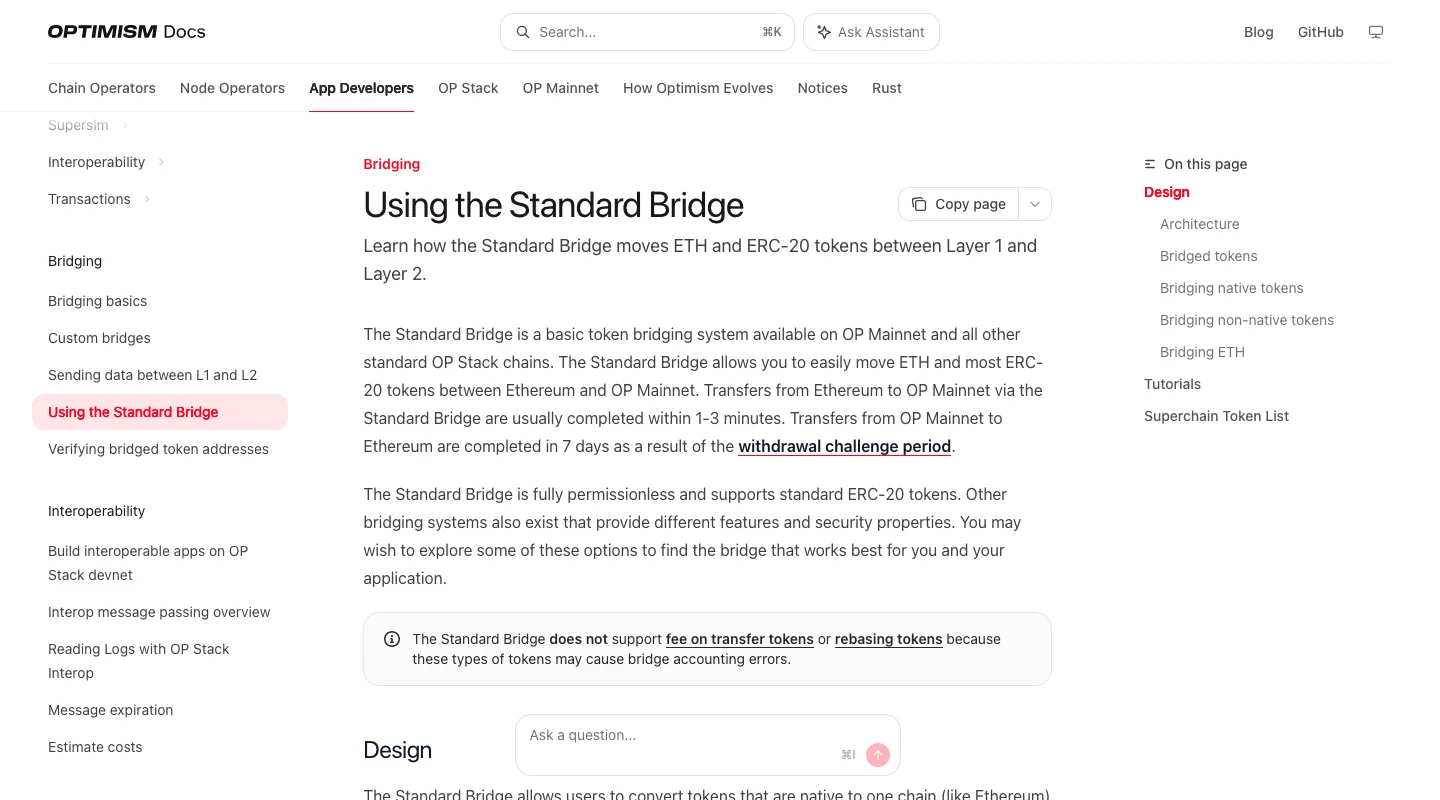
Official Standard Bridge documentation, including token limitations and withdrawal timing.
The documentation also notes that standard bridging does not support every token design. Fee-on-transfer and rebasing tokens can create accounting problems. A token with the same name on both networks is not enough evidence that it is the intended bridged representation.
The current bridge frontend matters
Optimism’s public bridge page now points users toward ecosystem bridge providers instead of operating one single OP Mainnet frontend. The page also says those providers are independent third parties.
This is an important operational detail. Reaching a provider through an Optimism page does not remove the need to inspect the provider’s domain, contracts, fees, arrival estimate, and failure process. A faster liquidity bridge is not the same mechanism as a standard withdrawal.
Lower fees do not mean lower application risk
Users can still lose funds by:
- Sending assets to the wrong OP Stack network.
- Receiving a thinly traded or incorrect bridged token.
- Mistaking a third-party fast bridge for the standard bridge.
- Arriving without ETH for the next OP Mainnet transaction.
- Signing an approval on a fake bridge or airdrop page.
- Assuming an application is safe because the network fee is small.
First-use checklist
- Confirm the target application requires OP Mainnet rather than another OP Stack chain.
- Start from optimism.io or docs.optimism.io.
- Verify network name, Chain ID, source chain, and destination chain in the wallet.
- Check the token contract and bridged representation.
- Use a small first transfer and keep the transaction hash.
- Before returning to Ethereum, identify whether the route is a standard withdrawal or a third-party liquidity bridge.
- Confirm the expected time and fees before signing.
Optimism vs Arbitrum
For most users, the meaningful differences are application availability, token liquidity, bridge routes, and exit assumptions. Standard exits from both ecosystems can involve an approximately seven-day challenge period, but their implementations and third-party bridge markets differ.
Related: Arbitrum explained and Base explained.
Sources and review method
- Optimism official website
- Optimism documentation
- Standard Bridge documentation
- Optimism bridge entry page
We reviewed public pages and official documentation without connecting a wallet or transferring assets. Last verified: 2026-07-18T00:24:00+08:00. Bridge and onchain actions can be irreversible; this guide is educational, not financial advice.
Keep reading
USDT on TRC20 or ERC20? Networks, Fees and Checks Before You Send
TRC20 and ERC20 are USDT on TRON and Ethereum. Addresses, fees and checks differ. Based on Tether, TRON and Ethereum docs: how to choose and what to check.

What Is Address Poisoning? Zero-Value Transfer Scams and How to Avoid Them
Address poisoning slips a look-alike address into your history with a zero-value transfer. How it works and how to avoid it, per MetaMask and Etherscan.
How to compare Web3 projects by purpose
Compare Web3 projects by purpose, costs, permissions and exit rules. Learn how networks, swap protocols and wallets differ, with a practical Base example.
Why estimated and final gas fees can differ
Distinguish an estimate, a fee cap, and actual usage when reading wallet prompts and transaction receipts.
Why an address must be checked with its network
Why does one wallet address show different balances on different networks? Check transfer networks, receiving addresses and token contracts.
Gas Too Expensive? Five Things That Actually Work (and Three That Don't)
How do you cut gas costs? Five methods that work — Layer 2, off-peak timing, batching, correct gas settings, fewer transactions — plus three that don't.