



What Is Jupiter? Solana Swap Routing and Ultra Mode
Jupiter is a Solana trading and liquidity-routing interface. This hands-on page review explains Swap routing, Ultra and Manual modes, order types, and the checks beginners should make.

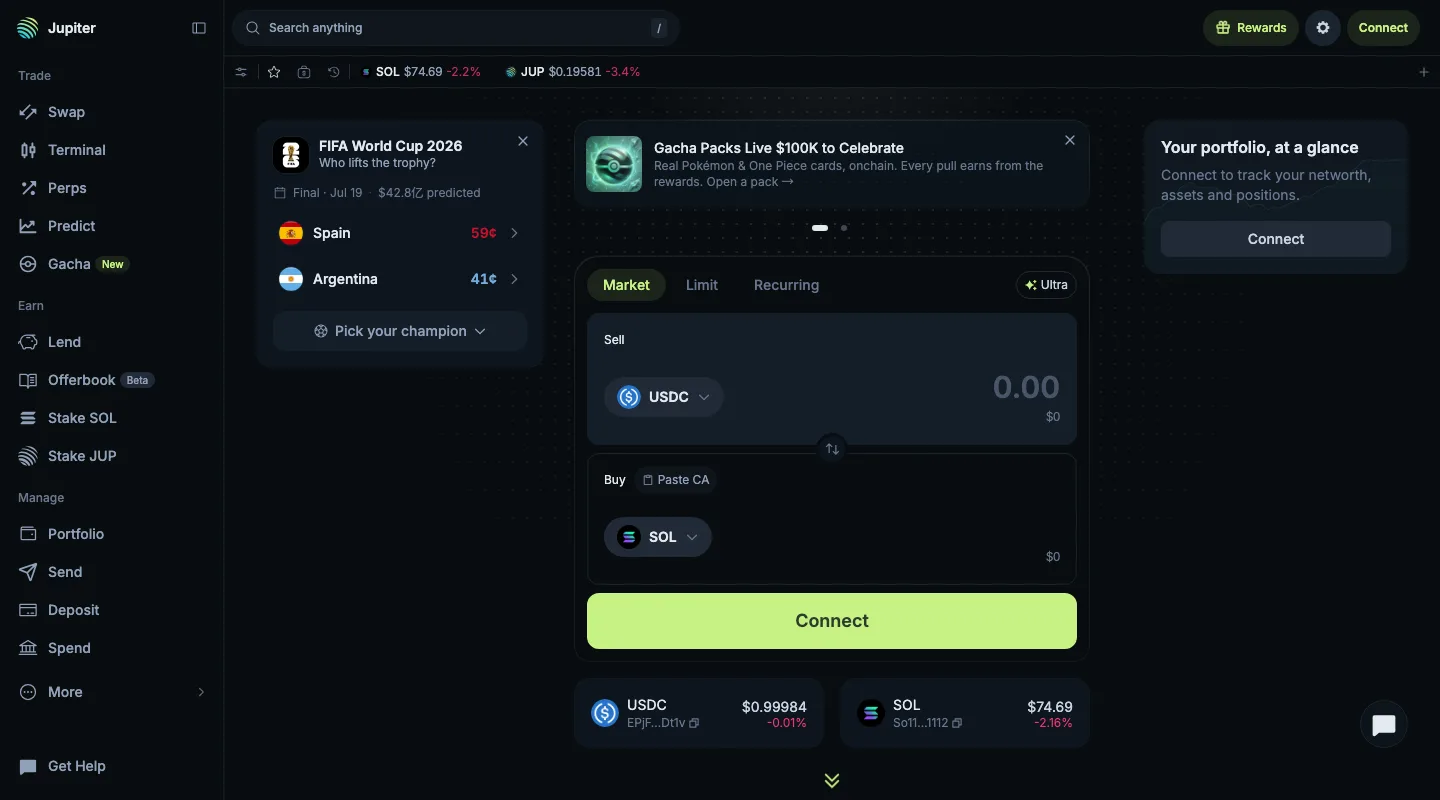
Jupiter is a trading and liquidity-routing interface in the Solana ecosystem. Its core job is not to operate only one liquidity pool. It searches across multiple sources and selects a route that balances price, speed, success rate, and execution conditions.
Short verdict: Jupiter is useful for someone who already understands Solana wallets, token addresses, slippage, and price impact. Routing can improve execution, but it cannot determine whether a token is legitimate or worth buying.
Jupiter’s public Swap interface without a connected wallet. Prices and promotions change continuously. Checked on 18 July 2026.
What the current interface shows
During this review, the central Swap card displayed Market, Limit, and Recurring tabs with an Ultra-mode indicator. The sidebar also exposed Terminal, Perps, Predict, Lend, staking, portfolio, send, deposit, and spending products.
That product density matters for beginners. A spot swap, a perpetual position, a prediction market, and a lending product do not share the same risk structure merely because they appear under one brand. A first-time user should stay focused on the specific action being researched.
The interface also displayed market and promotional cards. Their presence on an official page is not a BlockVar recommendation, nor proof that an asset or activity is suitable in every jurisdiction.
How Jupiter Swap finds a route
Jupiter’s documentation said its Swap product scans liquidity in real time from Meteora, Raydium, HumidiFi, and more than 100 other sources. It may split a transaction and optimize the route using several execution factors.
That does not promise the lowest price in every block. Quotes move, liquidity changes, and the final result depends on slippage, priority fees, MEV conditions, and whether the transaction lands successfully.
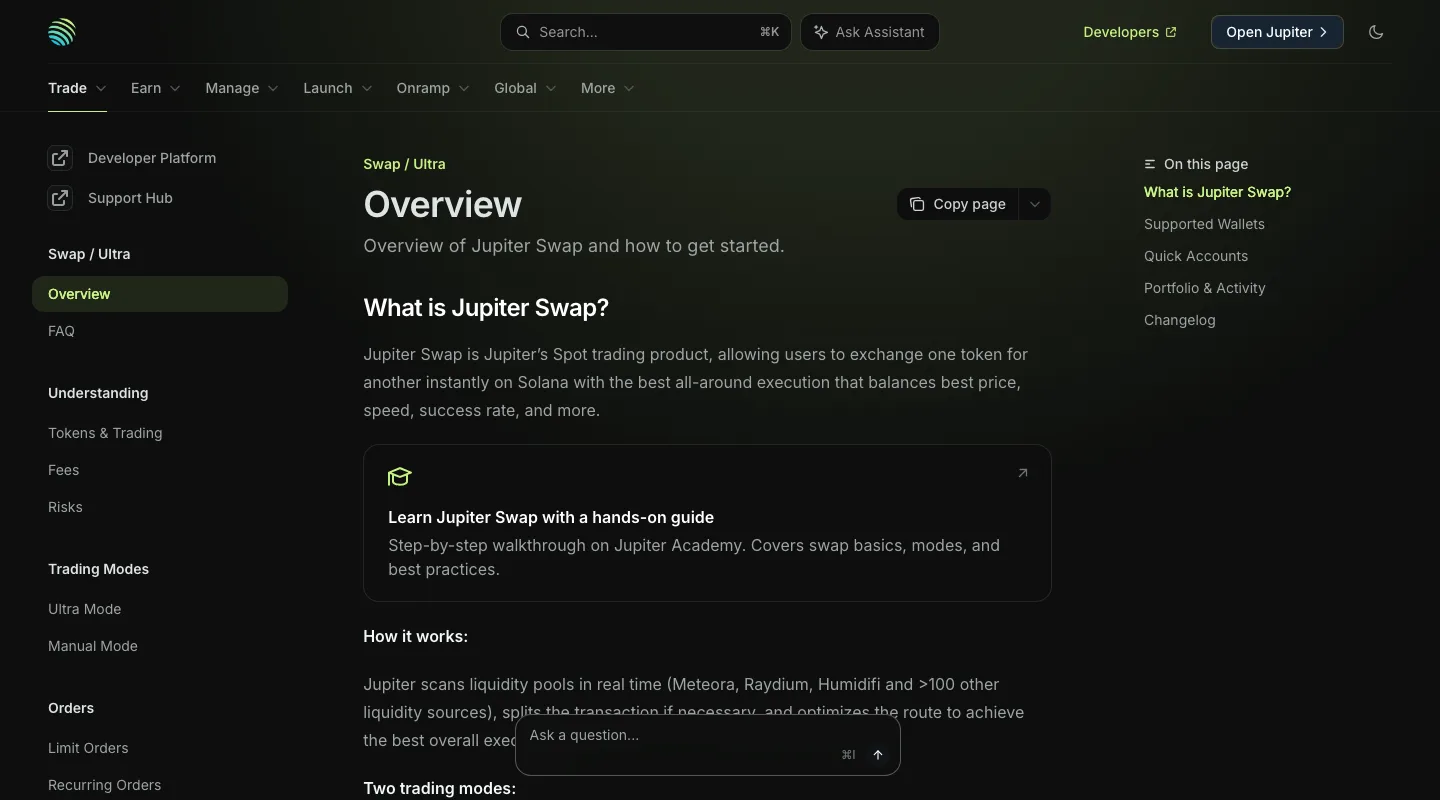
Official Jupiter Swap documentation with dedicated sections for fees, risks, Ultra Mode, and Manual Mode.
Ultra Mode vs Manual Mode
Jupiter describes Ultra Mode as automatically handling elements such as slippage estimation, transaction broadcasting, and priority fees. Manual Mode gives the user more direct control over those settings.
Automation can reduce configuration mistakes, but it is not a safety guarantee. Users must still check the input token, output token, minimum received amount, price impact, and wallet request.
Manual Mode is appropriate when someone understands why a parameter needs changing. Raising slippage simply to force a transaction through can produce much worse execution.
Market, Limit, and Recurring orders
- Market: attempts an exchange using currently available routes. The result remains sensitive to price movement and slippage.
- Limit: waits for a target condition before attempting execution. Triggering does not guarantee a full fill.
- Recurring: divides trades across scheduled intervals. It changes execution timing, not the underlying asset risk or expected return.
Tradability is not a quality signal. A token appearing in a route only means some executable liquidity may exist. It does not prove the contract is safe, the creator cannot mint or freeze tokens, or liquidity will remain available.
Beginner Swap checklist
- Use jup.ag and verify the browser address bar.
- Connect a learning wallet with only a small amount of SOL.
- Confirm the token contract address through an official project source or trusted explorer.
- Review price impact, minimum received, and route details.
- Do not raise slippage without understanding the cost.
- Make a small first trade and verify the result in a Solana explorer.
- Treat Perps, Predict, and Lend as separate products requiring separate research.
Jupiter vs Uniswap
Jupiter primarily routes liquidity across Solana venues. Uniswap is an AMM-centered protocol deployed across Ethereum and related networks. Both support token swaps, but their wallets, routing models, token systems, and network risks differ.
Related: Uniswap explained and Phantom Wallet explained.
Sources and review method
We reviewed the public interface and official documentation without connecting a wallet or submitting a trade. Last verified: 2026-07-18T00:32:00+08:00. Prices, routes, and supported features change; this is educational content, not trading or investment advice.
Keep reading
Does a new pool mean a new token?
Separate pool creation, token launch, and first discovery before interpreting a new listing.

What Is Optimism? OP Mainnet vs OP Stack
What is Optimism, one network or many? What OP Mainnet, OP Stack and the Superchain each mean, and why withdrawals take about seven days.
What Is Arbitrum? Bridging and 7-Day Withdrawals
What is Arbitrum One and how do you bridge to it? How One and Nova differ, chain ID 42161, and why official withdrawals take about seven days.
Safe Multisig Wallet: M-of-N Setup and Key Risks
How does a Safe multisig actually work? What M-of-N approval means, how Safe relates to its signer wallets, and the setup choices you cannot undo.
Phantom Wallet: Supported Chains and Safety Basics
Which chains does Phantom actually support? Its current network scope, what self-custody means in practice, and which EVM networks are missing.
Rabby Wallet: Safety Checks and MetaMask Differences
Is Rabby Wallet worth switching to? How far its pre-signing checks go, how it differs from MetaMask in daily use, and what to do before migrating.