



Private Key vs Seed Phrase vs Wallet Address: Beginner Guide
A wallet address is a public identifier for receiving assets. A private key controls a specific account. A seed phrase can often restore a set of accounts. They are related, but th

Many beginners search for “private key vs seed phrase vs wallet address” only after something feels confusing in a wallet or DApp. This guide starts with a plain answer, then walks through a realistic scenario, practical checks, and common mistakes.
It is not financial advice, legal advice, or a security audit. Treat it as a beginner checklist that helps you slow down before you connect a wallet, sign a message, grant approval, bridge funds, or submit a transaction.
Plain Answer
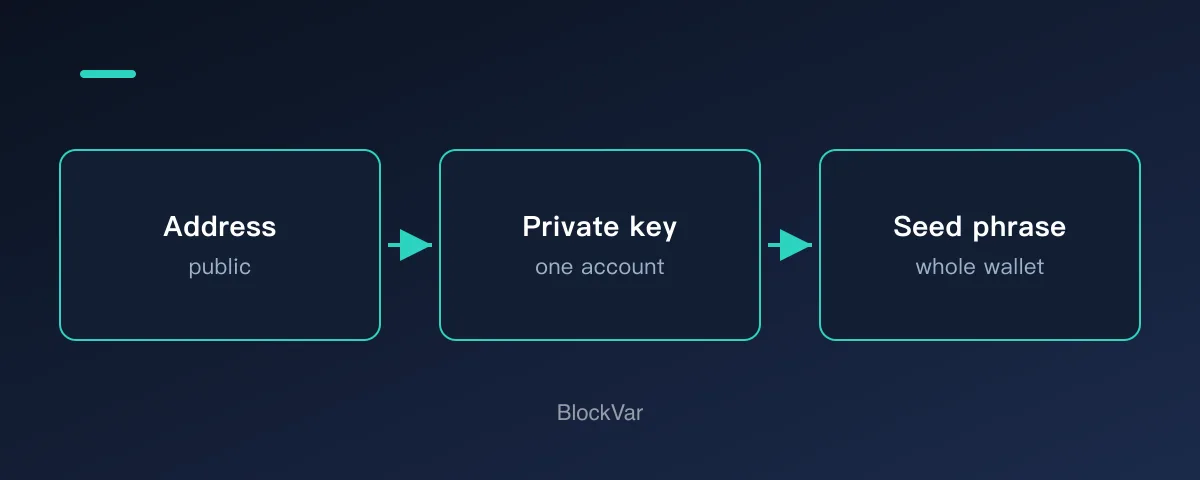
A wallet address is a public identifier for receiving assets. A private key controls a specific account. A seed phrase can often restore a set of accounts. They are related, but they should not be treated the same way.
The Part Beginners Usually Miss
A practical way to separate the terms is to ask whether it can be public. A wallet address can be shared for receiving assets and can be searched on block explorers. A private key or seed phrase should never be public because it can control funds. If a website asks for a private key or seed phrase, treat the request as high risk by default.
Why This Matters
Confusing these terms leads to dangerous behavior. Some beginners are afraid to share an address, while accidentally typing a private key or seed phrase into a website.
A Common Scenario
When someone sends you assets, they need your address. They do not need your private key or seed phrase. Recovery information should only be used in trusted wallet software and only when you understand why it is needed.
A Simple Decision Rule
For receiving funds, share an address. If a transfer flow asks for a private key or seed phrase, stop immediately.
Beginner Checklist
- Share only the wallet address when receiving funds.
- Check that the network matches the asset and sender.
- Never send a private key or seed phrase to another person.
- Test a new wallet with small amounts before relying on it.
When you are unsure, use this test: any page asking for more than an address is worth pausing on until you have verified where it came from.
Common Mistakes
- Copying a private key when you meant to copy an address.
- Thinking an exposed address means the wallet is compromised.
- Saving secret material as screenshots or plain notes.
What to Do Next
Once the three are clear, keep one rule: the address can be shared freely, the private key and seed phrase never. Receiving funds needs only the address. A private key or seed phrase is used only when importing a wallet, and no legitimate product will ever ask for one in a web form.
Next, save the addresses you use often into your wallet's address book to cut down on paste errors. Then read about approvals — a third kind of permission that is neither a key nor a phrase, but which also lets someone move your funds.
Related Reading
- What Is a Seed Phrase, and Why Should You Never Share It?
- What Is a Web3 Wallet, and How Is It Different from an Exchange Account?
- How to Check a Web3 Project Before Connecting Your Wallet
- What Is a Hardware Wallet, and When Do You Need One?
- Small Amounts: Should You Keep Them on an Exchange or in a Wallet?
References
- MetaMask: Secret Recovery Phrase, password and private keys: https://support.metamask.io/start/user-guide-secret-recovery-phrase-password-and-private-keys/
- Ethereum.org: Ethereum accounts: https://ethereum.org/guides/how-to-create-an-ethereum-account/
- Ethereum.org wallets: https://ethereum.org/wallets/
Keep reading
Is There a MetaMask Airdrop? Rewards After Season 1 and the $MASK Question
MetaMask says there are no current plans for a $MASK token, and Rewards Season 1 has ended. What Rewards offers now and how to spot fake airdrops.

What Are Web3 Points? Do Points Turn Into Tokens?
Points are a project's own participation record; whether they convert, and into what, is the project's call. Examples from Grass, MetaMask Rewards and Abstract.
What Is a Sybil Address? How Airdrops Filter Them Out
Being flagged as a Sybil means a project decided many addresses belong to one person. How detection works, per the Arbitrum Foundation's published methodology.
Wallet Hacked? What to Do First, Step by Step
After a wallet hack, find the cause first: a leaked seed phrase means a new wallet; abused approvals mean revoking. The steps, per MetaMask and Revoke.cash.
USDT on TRC20 or ERC20? Networks, Fees and Checks Before You Send
TRC20 and ERC20 are USDT on TRON and Ethereum. Addresses, fees and checks differ. Based on Tether, TRON and Ethereum docs: how to choose and what to check.
What Is Address Poisoning? Zero-Value Transfer Scams and How to Avoid Them
Address poisoning slips a look-alike address into your history with a zero-value transfer. How it works and how to avoid it, per MetaMask and Etherscan.