



What Does “Sign Message” Mean in a Crypto Wallet?
A wallet signature uses your wallet to confirm a message. It is often used for login, proving address ownership, or approving an off-chain action. It is not always a transfer, but

Many beginners search for “sign message wallet safety” only after something feels confusing in a wallet or DApp. This guide starts with a plain answer, then walks through a realistic scenario, practical checks, and common mistakes.
It is not financial advice, legal advice, or a security audit. Treat it as a beginner checklist that helps you slow down before you connect a wallet, sign a message, grant approval, bridge funds, or submit a transaction.
Plain Answer
A wallet signature uses your wallet to confirm a message. It is often used for login, proving address ownership, or approving an off-chain action. It is not always a transfer, but it can still be risky.
The Part Beginners Usually Miss
The biggest misconception is that a gas-free action has no consequence. A login signature may only prove ownership of an address, but some signatures can relate to orders, permissions, permits, or asset movement. The safer question is not only whether it costs gas; it is whether you understand what the signature says and whether the website is trustworthy.
Why This Matters
Because many signatures do not cost gas, beginners may assume they are harmless. Malicious signatures can be designed to approve orders, permissions, or actions that users do not understand.
A Common Scenario
A claim page asks you to sign a long or unreadable message. If the text does not match what you intended to do, or the domain is suspicious, stop before signing.
A Simple Decision Rule
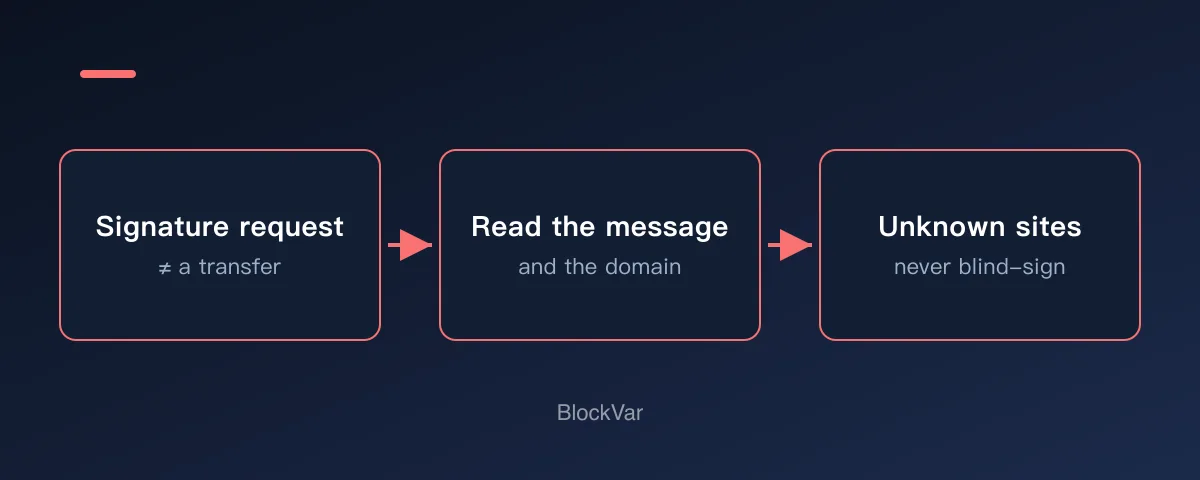
Before signing, ask: do I understand what this message authorizes? If not, do not sign.
Beginner Checklist
- Verify the website source before connecting.
- Read the message for domain, address, asset, amount, and permission details.
- Do not sign blank, unreadable, or unexpected messages.
- Avoid using your main wallet on unfamiliar sites.
Signatures do not appear on a block explorer, which is exactly why they get overlooked. The check has to happen before you sign; looking afterwards is usually too late.
Common Mistakes
- Thinking gas-free means risk-free.
- Treating Sign as a normal login button everywhere.
- Signing quickly because of countdowns or airdrop pressure.
What to Do Next
Next time a signature request appears, first work out whether it is plain text or structured data. Plain-text login signatures carry little risk. If the request contains a token name, an amount, or a spender field, stop and read every line.
Make it a rule: read the request fully before signing, and decline anything you cannot interpret. No legitimate flow requires you to sign something you do not understand immediately. If you have already signed something suspicious, check your approval list now — a permission granted by signature does not expire on its own.
Related Reading
- What Is a Token Approval, and How Do You Check and Revoke It?
- What Is a Wallet Drainer, and How Can Beginners Avoid It?
- What Is a Seed Phrase, and Why Should You Never Share It?
- What Does Minting an NFT Mean? A Pre-Mint Checklist
References
- MetaMask: Sign data with MetaMask: https://docs.metamask.io/metamask-connect/evm/guides/sign-data/
- MetaMask: Signature phishing: https://support.metamask.io/stay-safe/protect-yourself/wallet-and-hardware/signature-phishing/
- MetaMask security alerts: https://support.metamask.io/configure/wallet/security-alerts/
Keep reading
Is There a MetaMask Airdrop? Rewards After Season 1 and the $MASK Question
MetaMask says there are no current plans for a $MASK token, and Rewards Season 1 has ended. What Rewards offers now and how to spot fake airdrops.

Wallet Hacked? What to Do First, Step by Step
After a wallet hack, find the cause first: a leaked seed phrase means a new wallet; abused approvals mean revoking. The steps, per MetaMask and Revoke.cash.
What Is Address Poisoning? Zero-Value Transfer Scams and How to Avoid Them
Address poisoning slips a look-alike address into your history with a zero-value transfer. How it works and how to avoid it, per MetaMask and Etherscan.
Is Abstract Global Wallet Safe? Where the Keys of an Email-Login Wallet Live
Abstract Global Wallet lets you sign in with email, a social account or a passkey. From the official architecture docs: how the smart-contract wallet works, how its key is split into three shards, what recovery depends on, and the risks of session keys and cross-chain transfers.
How to Set Up a Binance Account: Regions, Verification, Security
Settle regional availability and verification tier before registering. Why funding carries more risk than fees, and four settings to finish on day one.
OKX Account vs Web3 Wallet: What to Settle Before You Start
One app holds two different things: a custodial exchange account, and a self-custodial Web3 wallet whose recovery phrase nobody can restore for you.