



What Is Gradient Network? Sentry Node Rewards Have Ended
Gradient Network is a Solana-ecosystem distributed AI infrastructure project backed by a $10M seed round led by Pantera and Multicoin. We verified the current status: the Sentry Node extension stopped earning rewards in August 2025, most farming tutorials are outdated, and no token has been announced.

Last verified on July 26, 2026, against Gradient's official website, documentation, GitHub repositories, and public funding reports. Project plans and reward policies change; always confirm against official pages before acting.
What is Gradient Network? In short, it is a Solana-ecosystem project building distributed AI infrastructure: the goal is to run large-model training and inference across an open network of everyday devices instead of a handful of centralized cloud data centers. The team calls this the Open Intelligence Stack, under the slogan "Towards Open Intelligence." Source: Gradient documentation
Many tutorials still describe Gradient as an "install the extension, farm the airdrop" project. That information is outdated — read the status check below before doing anything.
The most important fact first: Sentry Node no longer earns rewards
Gradient's official documentation now marks the Sentry Node Open Beta as Concluded. Season 1 ended on August 28, 2025, at 12:00 UTC, and Sentry Nodes stopped accumulating new Uptime and Tap rewards after that point. The documentation states it plainly: "Sentry Nodes do not receive rewards at the current moment." Source: Sentry Node Open Beta (Concluded)
What this means in practice:
- Installing the Sentry Node extension today earns you nothing;
- The "free Gradient farming" guides still circulating were mostly written in 2024–2025 and their reward math no longer applies;
- Any referral link claiming you can "still farm Gradient points today" deserves skepticism about its author's motives.
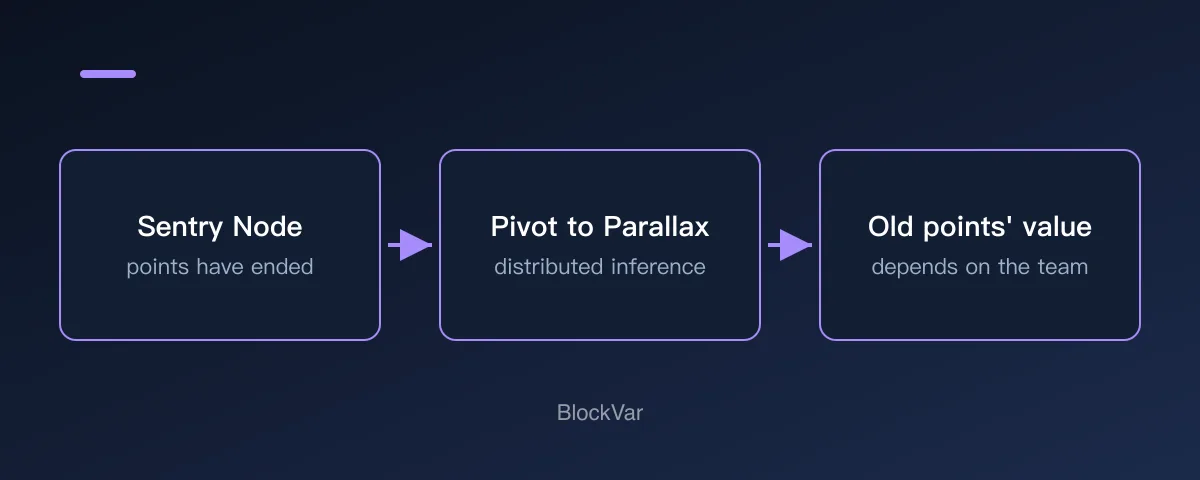
Diagram: Gradient's change of direction — Sentry Node points stopped and focus moved to Parallax; whether old points convert is undecided.
What was Sentry Node?
For the record: Sentry Node was a Chrome extension the project described as lightweight (under 1MB of data per month), privacy-preserving, and tolerant of intermittent uptime. Nodes periodically established peer-to-peer connections with each other to verify connectivity — each successful connection was called a "Tap." During the Open Beta, millions of participants completed over 2 billion peer-to-peer connections across 190+ regions.
The experiment's value to the project: those nodes collectively formed Lattica, Gradient's distributed data communication protocol and the network foundation for everything that followed. Participants' contributions were recorded as EXP points — whose eventual utility the team has never committed to (more below).
Team and funding: $10M led by Pantera and Multicoin
Gradient is based in Singapore. On June 17, 2025, the team announced a $10 million seed round led by Pantera Capital and Multicoin Capital, with participation from HSG (HongShan, formerly Sequoia China), to develop its two core protocols — Lattica and Parallax — using Solana to coordinate network data and settlement. Source: Decrypt
The official homepage currently displays Pantera, Multicoin Capital, and HongShan as backers. Source: gradient.network
The current product line: from farming extension to AI infrastructure
Since the Sentry Node era ended, Gradient's focus has shifted visibly toward engineering-heavy products and research:
- Parallax (distributed inference): a framework that shards large models across ordinary devices for cooperative inference, open-sourced on GitHub in September 2025 (GradientHQ/parallax) with 1,300+ stars. Anyone can try distributed inference through the Gradient Chatbot. Source: GitHub
- Echo (distributed reinforcement learning): a system for distributing AI post-training across heterogeneous devices, with published papers and some open-sourced models.
- Lattica (data communication protocol): evolved from the original Sentry Node network; it moves model weights and inference data between nodes worldwide. Live network activity is visible on the Gradient Explorer.
- Gradient Cloud (enterprise): an AI inference API service for developers and businesses.
The pivot itself is worth noting: the project did not stall at the points-extension stage — it shipped verifiable open-source code and research, which is rare among idle-farming projects and distinguishes it from pure hype networks.
Will Gradient points convert into a token or airdrop?
As of this writing, Gradient has not issued a token and has published no TGE timeline. The relationship between EXP points and any future token — ratio, snapshot rules, eligibility — has never been promised.
When evaluating claims, use a simple three-tier framework:
- Confirmed facts: the Open Beta has ended, points no longer accrue, funding and open-source progress are real;
- Official plans: the Edge Host program, further research releases, "more ways to participate coming soon";
- Unconfirmed speculation: token launch dates, EXP conversion ratios, airdrop eligibility.
A specific warning: searching "Gradient airdrop" surfaces third-party sites claiming you can "claim" tokens now. With no official token announcement, any page asking you to connect a wallet, sign a message, or pay a fee to claim a Gradient airdrop should be treated as phishing by default.
What can you actually do today?
The official participation paths right now:
- Edge Host Pilot Program: an invite-only program for operators with high-availability compute (GPUs, data-center bandwidth). You apply and wait for the team to reach out — a much higher bar than the old browser extension; Source: Edge Host Pilot Program
- Try the Gradient Chatbot and Explorer;
- Follow the open-source repositories, papers, and community channels.
In other words, Gradient today is a project to watch, not to farm. If you want projects with active reward programs, see our upcoming analyses in the Project Watch category — and verify each program's rules are still live before you commit time.
A checklist before you engage
- Ignore old tutorials: Sentry Node rewards have ended; any referral link selling that idea is outdated or misleading;
- Points are not tokens: EXP conversion rules were never published — never spend real money on an expected airdrop;
- Assume claim pages are phishing: until an official token announcement exists, every "claim" page is a scam — see our guide on claiming airdrops safely;
- Track hard signals: open-source code, papers, and enterprise customers say more than registered-node counts;
- Wait for official channels: new participation programs will appear in the official docs and the team's X account first.
Gradient is a candidate for that rare category: an idle-farming project that actually graduated. It used a massive extension experiment to bootstrap a network layer, then pivoted to AI infrastructure with real code and real research. Keep it on your watchlist — but throw away the old farming guides.
FAQ
Can I still earn points by installing Sentry Node?
No. Season 1 ended on August 28, 2025, and the official documentation states Sentry Nodes currently receive no rewards.
Are my old EXP points worth anything?
Unknown. The team has neither announced a use for EXP nor cancelled it. Keep your account, watch official announcements, and ignore third-party "conversion ratio" rumors.
Has Gradient launched a token?
No token and no TGE timeline exist as of July 26, 2026. Treat every "claim Gradient airdrop" page as phishing.
What is the legitimate way to participate now?
Apply for the invite-only Edge Host Pilot Program if you have serious compute resources; otherwise try the Chatbot and Explorer and follow official channels for new programs.
Related reading
- What Is a Crypto Airdrop, and How Do You Claim One Safely?
- What Is a Token Approval, and How Do You Check and Revoke It?
- How to Check a Web3 Project Before Connecting Your Wallet
- Your Node Points Went to Zero. Now What?
- What Is Vana? Personal Servers and Portable AI Memory
References
Keep reading
Is There a MetaMask Airdrop? Rewards After Season 1 and the $MASK Question
MetaMask says there are no current plans for a $MASK token, and Rewards Season 1 has ended. What Rewards offers now and how to spot fake airdrops.

What Are Web3 Points? Do Points Turn Into Tokens?
Points are a project's own participation record; whether they convert, and into what, is the project's call. Examples from Grass, MetaMask Rewards and Abstract.
What Is a Sybil Address? How Airdrops Filter Them Out
Being flagged as a Sybil means a project decided many addresses belong to one person. How detection works, per the Arbitrum Foundation's published methodology.
What Are Layer3 Liquid Rewards? CUBE Mint Rebates and L3 Lock Tiers
Minting a CUBE on Layer3 can earn L3 back at up to 100%, in five tiers set by locked L3 or L3 plus a league. See the conditions, how to claim and why the rate is not a yield.
How to Earn Abstract XP: Weekly Updates, Badges and the XP Multiplier
According to Abstract's Portal docs, XP comes from using apps listed on the Discover page, streaming and building apps. It updates weekly and cannot be transferred. Learn how badges are earned, where the multiplier comes from and what can cost you XP.
Do Galxe Quest Rewards Cost Money? Claim Fees, Gas and GG Explained
According to Galxe, only quests with a claim fee can award GG. Learn the difference between the platform claim fee and network gas, which networks are supported, how Galxe+ and levels reduce fees, and what to weigh before paying.