



What Is Vana? Personal Servers and Portable AI Memory
Vana is an open protocol for personal data sovereignty: your AI conversations, preferences and history live in a Personal Server you control, and apps get revocable permission to read them. We break down the MCP integration, the 1M-connected-users claim, and where VANA fits.

Verified against official sources on July 12, 2026. User and product figures are Vana's own disclosures; Personal Server and portable AI Memory remain in active iteration.
What is Vana? It is an open protocol and EVM-compatible network for personal data sovereignty. Users place data from AI, social, calendar, and health apps into a Personal Server they control, then grant revocable permissions for different applications to read it — instead of leaving their memory permanently locked inside single platforms.
AI assistants get better at knowing you — at the cost of your conversations, preferences, schedules, and long-term memory being siloed per platform. Switch models and the memory rarely comes along; run several AIs and you rebuild context in each. Vana inverts the relationship: data and memory live first in a user-controlled Personal Server, and the user decides which app can read what, for how long. The AI no longer owns your memory; it holds a revocable access grant.
On July 8, 2026, Vana announced the acquisition of the Memory Protocol team and an upgraded Vana App beta, providing a personal data server plus an MCP interface so that MCP-compatible AI tools can read the same user memory with permission. Source: Vana announcement
We include Vana in Project Watch because it keeps getting bundled into "idle farming" lists — wrongly. Vana is not an idle-node project: it wants your data-permission decisions, not your uptime. If a tutorial teaches you to "farm Vana by idling," its author has not understood the project.
What is a Personal Server?
Per the protocol docs, the Personal Server stores user data, responds to permission requests, and maintains access logs — it is the only component in the protocol that sees plaintext data. Source: Personal Server docs
Three deployment modes:
- Desktop-embedded: runs with the Vana desktop app; data stays local, but the server is unavailable when the app is closed;
- Vana cloud: an isolated micro-VM per user that wakes on request;
- Self-hosted: Docker deployment for advanced users, who take on availability and security themselves.
Users connect ChatGPT conversations, Spotify history, calendars, health devices and more, stored by scope. Developers cannot scrape everything — they must hold a valid grant; the server checks signatures, scope, and expiry, and records access history. The best analogy: a personal data mailbox, where the desktop app is the client and the Personal Server is the server that stores and sends.
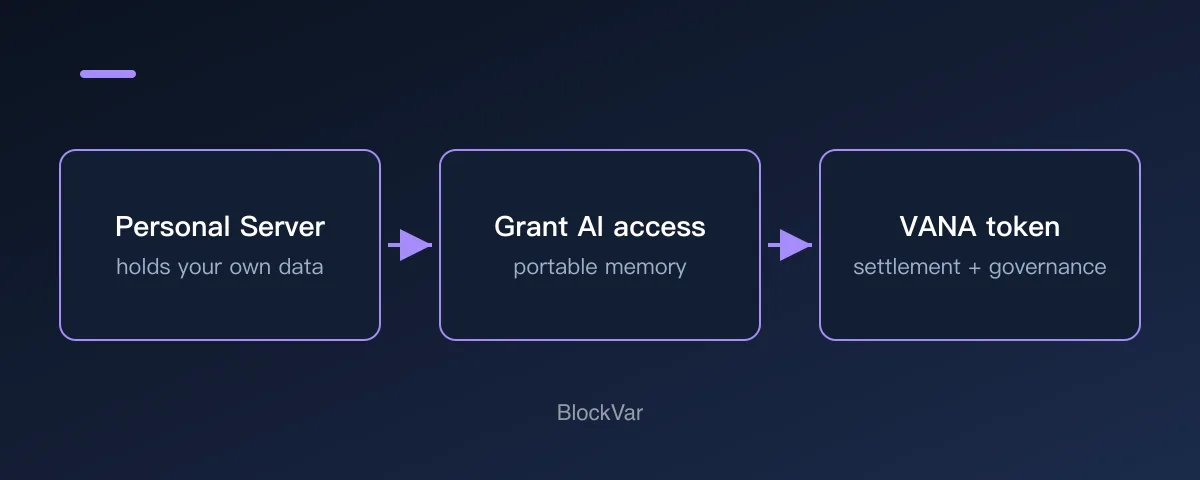
Diagram: Vana's design — your data stays on your Personal Server, AI accesses it by permission, VANA handles settlement and governance.
Why MCP matters
MCP gives different AI tools a relatively uniform way to call external data and tools. By exposing an MCP endpoint on the Personal Server, one authorized memory can serve multiple compatible apps — no re-uploading and re-maintaining per app. Let one AI read your authorized calendar and work notes, another read the same long-term preferences; revoke the grant and the app stops getting new data.
In theory, models then compete on reasoning quality and experience rather than on who locked your data in first. This is also the root difference from Grass: Grass organizes public web data at scale (coverage, freshness, pipelines); Vana handles private data users deliberately connect (consent, permissions, portability, revocation).
What does "over 1 million connected users" mean?
Vana's site reports more than 1 million users have connected data. Source: vana.org The number shows "reclaiming platform data" resonates, and gives developers a potential user base.
But "connected once" and "runs a personal server continuously" are different things. The metrics that decide network value: monthly data-syncing users, grants issued to third-party apps, whether data calls produce fees or verifiable usage, whether users understand and actively revoke scopes, and whether breaches or malicious apps get stopped in time. Vana's recent Builder Workshops and Office Hours suggest the focus is shifting from data contributors to developer adoption. Source: Vana community channels
Data sovereignty is not automatic security
Giving users control solves ownership and consent — it does not remove security risk. The Personal Server is the single plaintext component: compromise the device, cloud instance, or grant keys, and what leaks is a cross-platform, aggregated digital portrait.
Desktop mode keeps data local but ties availability to your device; cloud mode is convenient but reintroduces provider and key-custody risk; self-hosting maximizes control and hands you maintenance, backups, and incident response. Vana's success therefore hinges on permission UX: ordinary users must be able to see who reads what, for how long, and why — and revoke with one click — rather than parse raw addresses and signatures.
What role does the VANA token play?
Vana is an EVM-compatible network with VANA fixed at 120 million supply. Documented uses: network gas, validator staking, governance, Data Validator incentives, and the default access/transaction asset for data applications and DataDAOs. Source: VANA token docs
That is more concrete than pure governance — Personal Server registration, permission records, and data transactions need on-chain coordination. But the new data-portability API abstracts gas behind a Gateway, so developers and users may never touch VANA directly. Good for adoption; it leaves the value-capture question open. Watch on-chain operation volume, validator income, DataDAO data purchases, and developer payments — not just connected-user counts.
BlockVar's take
Vana picked an entry point people actually understand — portable AI memory — and turned data sovereignty from a slogan into an experience: switch models without amnesia, share one context across AIs under permission. Five things to track:
- Personal Server beta stability and retention;
- whether MCP connections reach mainstream AI tools beyond demos;
- third-party app review, least-privilege defaults, and incident handling;
- how many of the 1M+ connected users keep syncing and granting;
- whether app calls convert into validation, settlement, and real VANA demand.
If Vana hides key management and permissions behind a simple product, it could become the personal data layer of the AI era; if not, it stays a compelling demo.
FAQ
Is Vana an idle-farming project?
No. There is nothing to keep online for points. Vana asks you to connect data sources and manage permissions; its value comes from data portability, not uptime.
Does Vana see my data?
By design, only your Personal Server touches plaintext, and you choose where it runs (local, Vana cloud micro-VM, or self-hosted). Each mode carries different trust assumptions — read them before connecting sensitive sources.
Is the VANA token live?
Yes — VANA is the gas, staking, and governance asset of the network (120M fixed supply). Note that the Gateway abstracts gas for many operations, so users may not need to hold it for basic use.
What is the relationship between Vana and MCP?
Vana's Personal Server exposes an MCP endpoint, letting MCP-compatible AI tools read authorized user memory in a standard way — that is the mechanism behind "portable AI memory."
Related reading
- What Is Nodepay Now? From Bandwidth to the Signal Engine
- What Is Bless Network? 5M Nodes and the Shared Computer
- Grass in 2026: Revenue Up, USDC Rewards, Token Debate
References
Keep reading
Is There a MetaMask Airdrop? Rewards After Season 1 and the $MASK Question
MetaMask says there are no current plans for a $MASK token, and Rewards Season 1 has ended. What Rewards offers now and how to spot fake airdrops.

What Are Web3 Points? Do Points Turn Into Tokens?
Points are a project's own participation record; whether they convert, and into what, is the project's call. Examples from Grass, MetaMask Rewards and Abstract.
What Is a Sybil Address? How Airdrops Filter Them Out
Being flagged as a Sybil means a project decided many addresses belong to one person. How detection works, per the Arbitrum Foundation's published methodology.
What Are Layer3 Liquid Rewards? CUBE Mint Rebates and L3 Lock Tiers
Minting a CUBE on Layer3 can earn L3 back at up to 100%, in five tiers set by locked L3 or L3 plus a league. See the conditions, how to claim and why the rate is not a yield.
How to Earn Abstract XP: Weekly Updates, Badges and the XP Multiplier
According to Abstract's Portal docs, XP comes from using apps listed on the Discover page, streaming and building apps. It updates weekly and cannot be transferred. Learn how badges are earned, where the multiplier comes from and what can cost you XP.
Do Galxe Quest Rewards Cost Money? Claim Fees, Gas and GG Explained
According to Galxe, only quests with a claim fee can award GG. Learn the difference between the platform claim fee and network gas, which networks are supported, how Galxe+ and levels reduce fees, and what to weigh before paying.