



What Is Pipe Network? Life After Mainnet and the PIPE Token
Pipe Network is a Solana-based decentralized CDN that launched mainnet in October 2025, listed the PIPE token, and has since repositioned as "The AI Cloud." We verify why the testnet farming window is closed and what node participation actually means now.

Last verified on July 26, 2026, against Pipe Network's official website, the mainnet launch announcement, and public funding reports. Project plans and reward policies change; always confirm against official pages.
What is Pipe Network? Developed primarily by Permissionless Labs, it set out to build a decentralized CDN (content delivery network) on Solana: globally distributed PoP (Point of Presence) nodes deliver data from close to the user, replacing centralized CDN data centers. Open the official site in 2026, though, and the positioning has evolved into "The AI Cloud" — leading with an AI Router and an "AI Answer Layer," a cloud built for AI workloads. Source: pipe.network
Most people met Pipe through early-2025 testnet farming guides: "run a node, wait for the airdrop." As with Gradient, the phase those guides describe is over.
Status first: the testnet farming window is closed
Three dates tell the story:
- September 2024: Permissionless Labs closed a $10 million Series A led by Multicoin Capital, with Solana Ventures, Robot Ventures, and Solana co-founder Anatoly Yakovenko participating. Source: The Block
- 2025: the testnet ran, and ordinary users could operate light PoP nodes for points — the era the farming tutorials come from. Officially, the testnet grew to roughly 290,000 PoP nodes and delivered 60+ petabytes across more than a billion files.
- October 8, 2025: mainnet launched, the PIPE token began trading the same day, and about 2.5 million testnet tokens were burnt. Source: mainnet announcement (PR Newswire)
Mainnet means the accumulate-points-and-wait era is finished. Node participation is now real network operation: PIPE is earned for verified bandwidth and storage actually delivered, under reputation and staking mechanics. Any guide still teaching "free Pipe testnet farming" belongs in the same bin as the outdated Gradient ones.
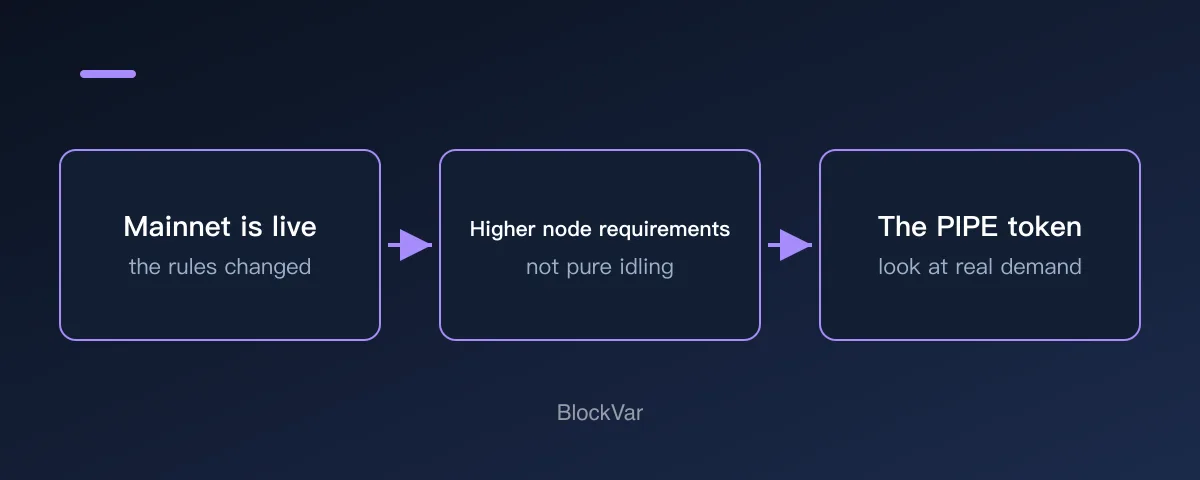
Diagram: the post-mainnet reality — requirements went up, pure idling shrank, and token value still comes back to real demand.
What participation looks like after mainnet
Per the launch announcement, two mechanics matter:
- Performance-based node rewards: PoP operators earn PIPE for verified bandwidth, storage, and uptime actually used by the network — not for merely registering or idling online;
- Stake delegation: a planned liquid-staking delegation program with the Jito Foundation lets PIPE holders stake and have their stake delegated to PoP nodes that meet bandwidth and uptime criteria — participation without operating hardware.
In other words, the bar moved from "install a plugin" to "run a real node or stake the token." It is the same direction Grass took when it re-weighted rewards from online time toward actually-used bandwidth: networks only want to pay for resources that get used. For the pattern across the whole sector, see our idle-DePIN comparison (Project Watch).
The workdrop controversy at listing
PIPE opened around $0.30 and pulled back after listing. The launch-period "workdrop" (double rewards for early node operators) triggered a community debate about allocation fairness — the familiar script in which early testnet participants' expectations exceed the final distribution. Source: CoinLaunch project page
The general lesson: treat points-to-token ratios as unknown until the very end. Teams almost never commit in advance, and outcomes below community expectations are the norm, not the exception.
From CDN to AI Cloud: what the pivot signals
The 2026 homepage is fully AI-first: "PIPE NETWORK — THE AI CLOUD," "AI Answer Layer," "The cloud built for AI workloads," with AI Router in the navigation and enterprise sales at pipenetwork.ai.
Combined with real Solana-ecosystem work — like cutting block-history snapshot sync time by about 30% for some validators (Blockworks) — the pivot reads as: the distributed PoP network is the foundation, CDN was the first application, and AI traffic delivery is the product it now wants to sell. Gradient moving from a farming extension to distributed AI infrastructure and Grass moving from training data to live retrieval are the same migration: DePIN projects are collectively chasing AI-side demand for revenue.
For participants this cuts both ways: the AI narrative expands the revenue story, but it also means success depends increasingly on enterprise customers paying — not on how many community nodes exist.
Checklist before you engage
- Ignore testnet-era guides — mainnet is live; old point-farming math is void;
- Cost out a node before running one — mainnet PoP requirements (stable bandwidth, storage, uptime) exceed the old testnet bar; check whether your resources and power costs make sense;
- Staking is not risk-free — token volatility and delegation mechanics carry real risk; be wary of high advertised yields;
- The token already trades — beware fake "late claim" pages — any site offering testnet users a retroactive airdrop for a wallet connection or fee is phishing: see claiming airdrops safely;
- Watch enterprise customers, not node counts — after the AI Cloud pivot, paying traffic matters more than "290,000 nodes."
Pipe Network earns a watchlist spot for the same reasons Gradient does: real funding, a real mainnet, real Solana use cases, and a completed transition from points experiment to token economics. But "worth watching" and "worth idle-farming" are different things — that second window has closed.
FAQ
Can I still run a Pipe testnet node for points?
No. Mainnet launched on October 8, 2025; the testnet points phase ended and about 2.5 million testnet tokens were burnt. Node participation now means operating a real PoP that earns for verified delivery.
When did the PIPE token launch?
Trading began October 8, 2025, alongside mainnet, opening around $0.30. Prices are volatile; nothing here is investment advice.
Can I participate without running a node?
A liquid-staking delegation program with the Jito Foundation is planned, delegating staked PIPE to qualifying PoP nodes. Check official announcements for current rules.
How does Pipe differ from Grass and Gradient?
All three organize distributed node resources, but sell different things: Grass sells web data, Gradient runs distributed AI inference, Pipe sells data delivery and is pivoting toward AI traffic. What they share: all three have left the pure idle-farming stage.
Related reading
- What Is Gradient Network? Sentry Node Rewards Have Ended
- What Is DAWN Network? Validator Points, Airdrop Odds, Risks
- What Is a Crypto Airdrop, and How Do You Claim One Safely?
References
Keep reading
Is There a MetaMask Airdrop? Rewards After Season 1 and the $MASK Question
MetaMask says there are no current plans for a $MASK token, and Rewards Season 1 has ended. What Rewards offers now and how to spot fake airdrops.

What Are Web3 Points? Do Points Turn Into Tokens?
Points are a project's own participation record; whether they convert, and into what, is the project's call. Examples from Grass, MetaMask Rewards and Abstract.
What Is a Sybil Address? How Airdrops Filter Them Out
Being flagged as a Sybil means a project decided many addresses belong to one person. How detection works, per the Arbitrum Foundation's published methodology.
What Are Layer3 Liquid Rewards? CUBE Mint Rebates and L3 Lock Tiers
Minting a CUBE on Layer3 can earn L3 back at up to 100%, in five tiers set by locked L3 or L3 plus a league. See the conditions, how to claim and why the rate is not a yield.
How to Earn Abstract XP: Weekly Updates, Badges and the XP Multiplier
According to Abstract's Portal docs, XP comes from using apps listed on the Discover page, streaming and building apps. It updates weekly and cannot be transferred. Learn how badges are earned, where the multiplier comes from and what can cost you XP.
Do Galxe Quest Rewards Cost Money? Claim Fees, Gas and GG Explained
According to Galxe, only quests with a claim fee can award GG. Learn the difference between the platform claim fee and network gas, which networks are supported, how Galxe+ and levels reduce fees, and what to weigh before paying.