



What Is DAWN Network? USD.infra Vault, Validator Extension and Points Risks
DAWN began as a user-built decentralized broadband network and moved into digital infrastructure finance in September 2026. We break down the USD.infra Vault, the validator extension, points and airdrop expectations, and the risks to check first.

Updated on October 4, 2026 with DAWN's repositioning; see the October 2026 update section. The rest was verified on July 26, 2026, against DAWN's official website, roadmap, reward rules, privacy policy and terms of service. Roadmaps and reward policies change; always confirm against official pages.
What is DAWN Network? In short, DAWN wants to rebuild broadband — currently controlled by large carriers — as an open network provided by its own users, deployers, and service partners. For ordinary users, the entry point is the Validator Extension: keep a browser online, participate in network verification, earn project points. The deeper network involves physical wireless hardware, bandwidth supply, paying subscribers, and on-chain coordination.
DAWN and Grass both use ordinary users' network resources, but they sell different things: Grass supplies web data to AI companies, while DAWN wants communities to build, verify, and sell internet connectivity itself. That is why DAWN cannot be judged as just another points extension — whether it can produce real broadband customers and revenue is the core of its long-term value.
October 2026 update: DAWN has moved into infrastructure finance
On September 15, 2026, DAWN announced the USD.infra Vault, which went live on September 22. Its website now presents DAWN as the capital layer for digital infrastructure, connecting on-chain capital with real-world assets (RWAs) and the cash flows they generate, and its homepage now leads with the vault. Source: DAWN USD.infra Vault announcement
- How the vault works: users deposit USD.infra and receive sUSD.infra, which represents their share. The capital supports defined, contracted network deployments, initially Internet deployments within the DAWN ecosystem, and the revenue those deployments generate services the contractual payments to capital providers.
- Initial targets: building-wide connectivity, acquiring smaller internet service providers, WiFi capacity for mobile operators, and AI compute deployments.
- Operating record: DAWN says that through Andrena, its initial deployment and operator partner, it has brought connectivity to more than 15,000 households across 10 states. That measures something different from the roughly 4 million households of coverage cited below from July, so the two cannot be compared directly.
- Returns and restrictions: as of October 4, 2026, the website showed a current APY of 4.64%, an expected APY of 9.3% and about $10.3 million in total value locked, noting that the figures are variable and not guaranteed. The vault is available only to eligible non-U.S. persons, using a VPN to get around restrictions is prohibited, and DAWN warns that participation can mean losing capital and that its announcement is not an offer.
- The validator extension: still available, but the website now describes its purpose as helping verify the AI infrastructure financed through DAWN. Neither the announcement nor the extension page mentions points or a token.
The sections below were verified in July 2026 and describe DAWN's earlier broadband-network model. They explain where DAWN came from; for what the project is and what it risks now, go by this section.
The core model: a user-owned broadband network
DAWN defines itself as a User-Owned Broadband Network. Its site describes four kinds of participants: Source: DAWN website
- Validators — run the extension (and future clients) to verify uptime and bandwidth capability;
- Deployers — install Black Box hardware and antennas to provide real network coverage;
- Subscribers — households and businesses who pay for connectivity;
- Partner operators and protocols — existing ISPs and DePIN services that plug into DAWN.
Compared with a pure points extension, this is a two-sided market: organize network supply on one side, find paying users on the other. Points cheaply recruit early validators, but coverage quality, subscriber counts, and network revenue are what ultimately prove the model.
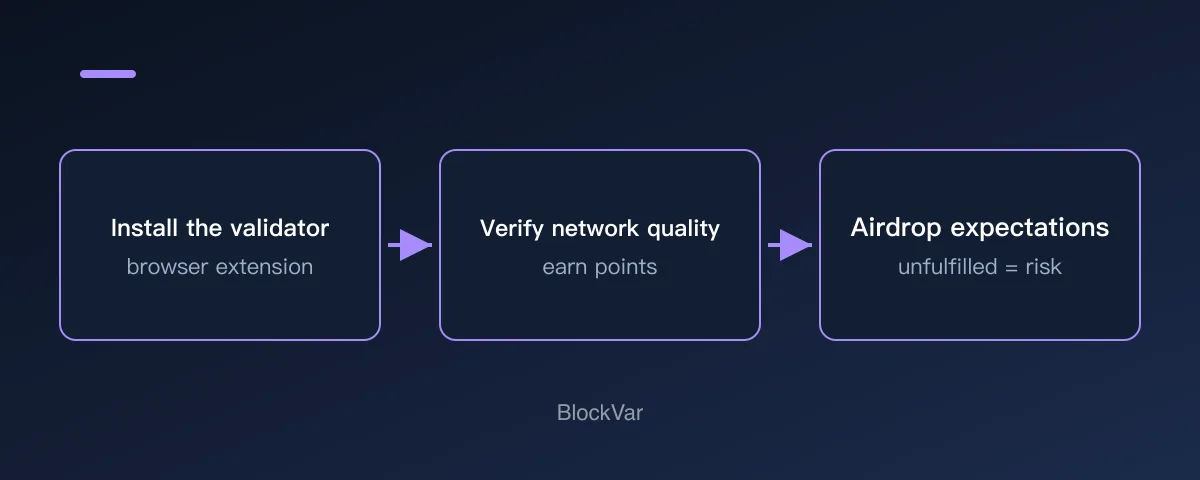
Diagram: the DAWN loop — the extension verifies network quality for points; until a token ships, that value is expectation, not fact.
What does the Validator Extension actually do?
The official onboarding is simple: install the Chrome extension, create an account, stay online, and accumulate rewards through uptime, referrals, and Proof-of-Bandwidth activities. The site currently claims more than 3 million validators worldwide. Source: DAWN Validator Extension
The early reward rules split points into four sources: staying connected (up to 1,440 base points per 24-hour cycle), referral tiers, one-time social tasks, and bandwidth-verification tasks when selected. Note that this published breakdown dates from 2024 and the team explicitly reserves the right to change it — use the extension's current display and the latest terms, not old formulas, to estimate anything. Source: DAWN rewards system
Proof of Bandwidth: being online is not the same as verifying bandwidth
Proof of Bandwidth (PoB) verifies that a node actually has the capacity it claims — through challenger/prover tests of speed, stability, and available bandwidth, not just an "online" indicator.
An easily missed detail: DAWN's Q1 2026 roadmap states that because of browser limitations, fuller PoB runs through a desktop application, not the extension alone — with UDP speed tests, Black Box capacity verification, plus an Explorer, deployer and subscriber dashboards, and a Solana testnet in the works. Source: DAWN Q1 2026 roadmap
So the Validator Extension is best understood as an early participation gateway and light verification layer — not a full broadband node. What decides whether the network works: hardware deployment, measurable bandwidth, actual subscribers, and stable settlement.
Will DAWN points become a token or airdrop?
As of this writing, DAWN points are not a confirmed token airdrop. This is the single most important conclusion in this article.
DAWN's Terms & Conditions state that points have no monetary value, are not transferable or redeemable for fiat, property, or anything of value, and may never convert into cash or crypto assets; the team also reserves the right to modify or terminate the rewards program and cancel points. Source: DAWN Terms & Conditions, §7.4
Community speculation about a TGE is understandable — a January 2026 AMA placed mainnet within about six months, with tokenomics and airdrop disclosures planned for Q2 — but as of late July 2026 no TGE date has been officially announced. Sort every claim into three tiers:
- Confirmed facts: the extension works, the points system runs, participant counts are displayed;
- Official plans: desktop app, Explorer, Solana testnet, mainnet targets;
- Unconfirmed speculation: conversion ratios, token launch dates, airdrop eligibility and value.
Anything claiming a fixed conversion ratio, a guaranteed airdrop, or asking you to pay to "activate eligibility" should be rejected outright — and with an unreleased token, fake claim pages are a certainty: see how to claim airdrops safely.
Beyond the points narrative: real deployment progress
To its credit, DAWN's story does not stop at the browser extension. Its Q1 2026 roadmap review reported that by the fourth quarter of 2025 the network covered about 4 million households, that the team had completed smart-contract audits with two firms, and that it had raised a $13 million Series B led by Polychain Capital. Its goal at the time was to reach 5.9 million households by the end of the first quarter of 2026. These figures all come from the project, and a target is not an achievement. Source: DAWN Q1 2026 roadmap
In February 2026, DAWN also announced a partnership with the broadband provider Flume to bring part of Flume's existing wireless network in New York into its open network model. DAWN says the partnership covers close to 1 million households, with more than 90% household coverage in the Bronx, and that further expansion is planned. Source: DAWN × Flume
These figures say more than how many people installed an extension, but they still need to be verified over time: coverage is not the same as paying subscribers, and a partnership announcement is not the same as stable revenue. If DAWN publishes active subscribers, network usage, the uptime of deployed devices and revenue sharing, it will be far easier to judge whether the business works.
How DAWN, Grass, Nodepay and Bless differ
| Project | Main resource users contribute | Main product direction | What to watch now |
|---|---|---|---|
| DAWN | Network connections, bandwidth verification, physical coverage | A user-built broadband network | Real deployments, subscriptions and points policy |
| Grass | Idle bandwidth and access to public web pages | AI training and real-time data | Customer revenue, node rewards and token value capture |
| Nodepay | Network- and data-related signals | AI Signal Engine | The product pivot and what the NC token is for |
| Bless | Device computing power | A distributed computing network | Real demand for compute and BLESS incentives |
Further reading: Grass's recent revenue and reward changes, Nodepay's Signal Engine and the NC token, Bless Network nodes and shared computing.
All four projects grow their networks with community devices, but a similar form does not justify the same valuation logic. For DAWN, the key figures are not total points but how much real network capacity has been verified, how many households can use the service, and whether deployers can earn a sustainable income.
Risk checklist before participating
1. Points and airdrops are uncertain
Points rules can change, be cancelled or never convert into any asset; the Terms & Conditions say so explicitly. Budget your costs on the assumption that there may be no token reward at all, rather than starting from an imagined conversion value.
2. Browser extensions and privacy
DAWN's privacy policy lists the data it may collect, including account information, IP address, device and browser information, network information, general location, activity records and wallet-related information. Read the permissions before installing, use a separate browser profile, and avoid installing unfamiliar extensions in the everyday environment where you keep valuable wallets. Source: DAWN Privacy Policy
3. Network and device costs
Staying online uses electricity, network resources and device lifespan. Buying a Black Box or deploying an antenna adds the hardware price, installation conditions, maintenance, local regulations, and the question of whether there is real user demand where you are.
4. Roadmap delivery risk
The Explorer, the desktop app, the testnet and coverage targets are staged plans. Distinguish "announced", "in testing" and "running reliably", and do not treat a roadmap date as proof of delivery.
5. Phishing and fake extensions
Reach the official installation page only from dawninternet.com. Offers to restore missed points, verify airdrop eligibility or sync a wallet, and "support" messages asking for a seed phrase, are all common high-risk scenarios.
6. Referral hype
Referral rewards amplify enthusiasm. A recruiter's income from referrals says nothing about whether the project itself works.
7. A yield vault is not a points campaign
Depositing USD.infra is an investment, not the same thing as running an extension for points. You can lose capital, the APY is not guaranteed, returns depend on infrastructure operators meeting their contracts, and smart-contract risk and regional restrictions come on top. We do not suggest depositing money as a way to take part in DAWN; if you are considering it, read the official vault terms and risk disclosures in full first. Source: USD.infra Vault Terms & Disclosure
BlockVar's view: worth watching, but not just as an airdrop
The most valuable part of DAWN is not its 3 million extension users but its attempt to put community incentives, real wireless coverage and broadband subscriptions into one market. If existing ISPs and deployers can join quickly, the project may avoid the high cost of building a network from scratch. If it ends up with a large number of browser accounts waiting for an airdrop and few paying users, its network size will remain a surface number.
Four indicators are worth tracking next:
- Whether the Explorer keeps publishing verifiable data on online nodes and coverage;
- Whether partnerships such as Flume turn into active subscribers and real traffic;
- How desktop Proof of Bandwidth and the Solana testnet actually run;
- Whether DAWN publishes clear rules for points, the token or the distribution of network revenue.
Until that information is available, DAWN is better treated as a test case for whether real-world broadband DePIN can work than as a predictable airdrop with an estimable return.
October 2026 addendum: after the pivot, the evidence that matters changes too. More telling than extension users are where the vault's money actually goes, whether the underlying contracts' terms and payment records are published, what happens when an operator defaults, and what the validator extension verifies in the new model and whether it still earns anything. Until that is public, the extension is better seen as a watch point with an undefined purpose than as a points campaign with an expected return.
FAQ
Is the DAWN airdrop confirmed?
No. Points accrue, but the terms of service state they have no monetary value and may never convert. A mid-2026 TGE window has been discussed in official AMAs, but no date or mechanics are announced.
How do I earn DAWN points today?
Install the official Validator Extension, stay online, complete social tasks, and refer users. Verify current rules in the extension itself — published formulas from 2024 may no longer apply.
Does running the extension use much bandwidth?
The extension itself is light; fuller bandwidth verification is planned for the desktop app. Check the privacy policy for what your connection is used for.
How is DAWN different from Grass?
Grass sells web data collected through residential bandwidth; DAWN wants to build and sell actual internet connectivity through community-deployed hardware. Different products, similar early-stage points mechanics.
Related reading
- What Is Gradient Network? Sentry Node Rewards Have Ended
- What Is a Crypto Airdrop, and How Do You Claim One Safely?
- How to Check a Web3 Project Before Connecting Your Wallet
References
Keep reading
Is There a MetaMask Airdrop? Rewards After Season 1 and the $MASK Question
MetaMask says there are no current plans for a $MASK token, and Rewards Season 1 has ended. What Rewards offers now and how to spot fake airdrops.

What Are Web3 Points? Do Points Turn Into Tokens?
Points are a project's own participation record; whether they convert, and into what, is the project's call. Examples from Grass, MetaMask Rewards and Abstract.
What Is a Sybil Address? How Airdrops Filter Them Out
Being flagged as a Sybil means a project decided many addresses belong to one person. How detection works, per the Arbitrum Foundation's published methodology.
What Are Layer3 Liquid Rewards? CUBE Mint Rebates and L3 Lock Tiers
Minting a CUBE on Layer3 can earn L3 back at up to 100%, in five tiers set by locked L3 or L3 plus a league. See the conditions, how to claim and why the rate is not a yield.
How to Earn Abstract XP: Weekly Updates, Badges and the XP Multiplier
According to Abstract's Portal docs, XP comes from using apps listed on the Discover page, streaming and building apps. It updates weekly and cannot be transferred. Learn how badges are earned, where the multiplier comes from and what can cost you XP.
Do Galxe Quest Rewards Cost Money? Claim Fees, Gas and GG Explained
According to Galxe, only quests with a claim fee can award GG. Learn the difference between the platform claim fee and network gas, which networks are supported, how Galxe+ and levels reduce fees, and what to weigh before paying.