



Why Do Node Accounts Get Banned? The Rules Nobody Reads
"Farmed for three months, banned overnight" is the most common post in every idle-node community. We compile the red lines shared across project guidelines — multi-accounting, VMs, datacenter IPs, referral abuse — explain how detection works, and how to appeal a false positive.

Updated July 2026. Each project's enforcement rules live in its own community guidelines; this article compiles the red lines and detection principles common across projects.
Open any idle-node project's Discord and "why was I banned?" is among the most frequent posts. Some posters cheated; some are false positives. This article compiles the red lines shared across project guidelines — because understanding what risk systems are defending against beats memorizing any single rulebook.
What detection defends: a one-paragraph economic explanation
Reward pools are finite, and the money comes from data or compute customers. Every cheating account's earnings come out of honest users' share and the project's credibility. So every project's risk system converges on the same goal: one reward should correspond to one real, independent, usable resource contribution.
From that principle, four behaviors are red lines everywhere.
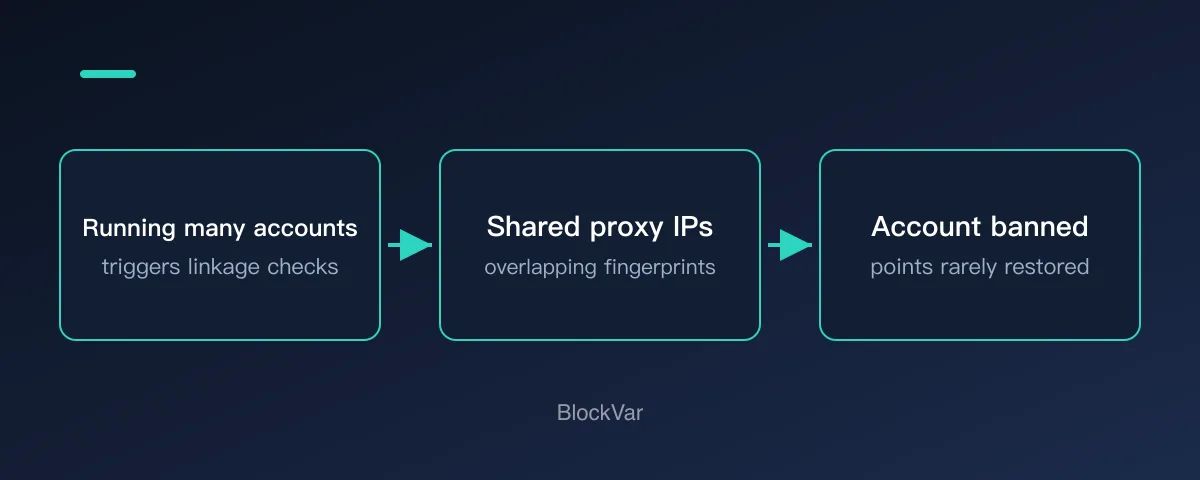
Diagram: the usual path to a ban — multi-accounting, shared IPs and overlapping fingerprints flagged as linked, then points wiped with the account.
Red line 1: multi-accounting
One person running many accounts is the most common violation and the easiest to catch. Detection has more inputs than most people assume: shared device fingerprints (hardware and browser characteristics), shared payout addresses, self-referencing referral chains, and synchronized behavior timelines — account clusters that register in sequence and go online/offline together are glaring in backend data.
Per-project allowances differ (Nodepay, for instance, once allowed up to 3 IPs per account — rules vary widely), but "multiple accounts pretending to be multiple people" is a ban reason everywhere.
Red line 2: virtual machines and device spoofing
Cloning "devices" with VMs is fabricating resource supply. VM hardware signatures (virtual NICs, virtual GPUs, hypervisor traces) are client-detectable, and VMs on one physical host share an egress IP and performance profile. Compute networks like Bless — which match tasks to device capability — are especially sensitive: a fake device that accepts tasks and fails them poisons network quality directly.
Red line 3: datacenter IPs, proxies, and IP pools
We covered the mechanics in What Is a Residential IP: IP types are a lookup away, and proxy-pool addresses are already flagged in commercial reputation databases. Running a "residential bandwidth" project through a datacenter IP or commercial proxy is self-reporting to the risk system. The worst combination is multi-accounts on a shared proxy pool — two red lines at once.
Red line 4: referral abuse
Referral rewards are a growth tool and a fraud magnet. Referring your own alt accounts, batch-registered "downlines," scripted referral signups — these typically get the downline banned, the referrer banned with them, and accumulated referral rewards zeroed. Any tutorial promising "unlimited referral farming" is a tutorial on donating your account to the ban queue.
Gray zones that catch honest users
Several scenarios are not deliberate cheating but emit the same signals:
- Housemates on one broadband line, each with their own account: same-IP multi-accounts are statistically indistinguishable from multi-boxing. Check how the project defines "household" before assuming it is fine;
- Frequently rotating public IPs (common in some regions): accounts hopping across IPs can get flagged;
- Security software or extensions disrupting the client: frequent disconnect/reconnect loops resemble scripting;
- A VPN left on: your egress becomes a datacenter IP — see red line 3.
The false-positive-avoidance formula: one account, one human, one independent network egress, official client, no VPN.
If you are banned: how to appeal properly
- Read the ban notice and the community guidelines to identify the violation category claimed;
- Use the official ticket/appeal channel (Discord support ticket or website form) — spamming public channels does not accelerate anything;
- Describe your network honestly: shared-household broadband and dynamic IPs are recoverable false-positive stories; actual multi-boxing appeals succeed at a rate near zero;
- Beware "paid unban" scams: anyone DMing you about fees or "internal channels" to restore an account is a scammer. Official appeals are free.
Pre-participation checklist
- Is my connection direct home broadband? (No → fix the IP situation first)
- Is anyone else on this line running the same project? (Yes → check the household rules)
- Am I using the official client? ("Multi-instance" builds = malware plus ban, a double loss)
- Are all my referrals real, independent people?
- Can I absorb the worst case — banned, points zeroed? (Points are database rows until redeemed; every ToS says so.)
FAQ
Can I just re-register with a new email?
With the same device fingerprint and IP, the new account will likely be linked and banned faster. Detection tracks humans and devices, not email addresses.
Will running several different projects on one computer get me banned?
Cross-project participation is not multi-accounting. But stacked clients change traffic and performance patterns, which occasionally trips anomaly detection — when troubleshooting, pause the other clients first.
Can banned points be recovered?
Almost every ToS states that points are void on violation bans and will not be restored. One more reason we keep repeating: points are not assets.
Related reading
- What Is a Residential IP, and Why Do Node Projects Want It?
- Grass in 2026: Revenue Up, USDC Rewards, Token Debate
- How to Spot Fake Airdrop Claim Sites Before You Connect
- Are Node-Farming Browser Extensions Safe? What to Check First
References
Keep reading
Is There a MetaMask Airdrop? Rewards After Season 1 and the $MASK Question
MetaMask says there are no current plans for a $MASK token, and Rewards Season 1 has ended. What Rewards offers now and how to spot fake airdrops.

What Are Web3 Points? Do Points Turn Into Tokens?
Points are a project's own participation record; whether they convert, and into what, is the project's call. Examples from Grass, MetaMask Rewards and Abstract.
What Is a Sybil Address? How Airdrops Filter Them Out
Being flagged as a Sybil means a project decided many addresses belong to one person. How detection works, per the Arbitrum Foundation's published methodology.
USDT on TRC20 or ERC20? Networks, Fees and Checks Before You Send
TRC20 and ERC20 are USDT on TRON and Ethereum. Addresses, fees and checks differ. Based on Tether, TRON and Ethereum docs: how to choose and what to check.
What Are Layer3 Liquid Rewards? CUBE Mint Rebates and L3 Lock Tiers
Minting a CUBE on Layer3 can earn L3 back at up to 100%, in five tiers set by locked L3 or L3 plus a league. See the conditions, how to claim and why the rate is not a yield.
How to Earn Abstract XP: Weekly Updates, Badges and the XP Multiplier
According to Abstract's Portal docs, XP comes from using apps listed on the Discover page, streaming and building apps. It updates weekly and cannot be transferred. Learn how badges are earned, where the multiplier comes from and what can cost you XP.