



Grass in 2026: Revenue Up, USDC Rewards, Token Debate
Grass reported $17M in H1 2026 revenue and says the business is profitable — while switching Stage 2 rewards to USDC and re-weighting payouts toward actually-used bandwidth. We break down what changed, why node earnings fell for many users, and the GRASS value-capture debate.

Based on Grass's official H1 2026 Token Holder and Network Participant Call (July 7, 2026) and the official recap and reward documentation published July 10, 2026. Revenue and cost figures are the project's own disclosures, not independently audited. Verified July 26, 2026.
Grass runs the best-known bandwidth-sharing network in crypto: distributed nodes contribute idle residential bandwidth used to collect and structure public web data, which is sold to AI companies. In July 2026 it delivered two very different messages at once: the business side announced accelerating revenue and profitability, while the community side erupted over Stage 2 rewards being paid in USDC and payout differences between users.
That tension is the story. Grass is transitioning from a token-incentive-driven DePIN into a data infrastructure business driven by client revenue — and the hard question is how business value flows back to node operators and token holders.
The numbers: real revenue growth, with one caveat
Per the official recap: revenue was $2.7M in H1 2025 and $14.3M in H2 2025 ($17M for the year); H1 2026 hit $17M again — roughly 6.3× the same period last year — with 2026 training-data revenue projected at $65–75M. The team reports monthly cash costs of $2–3M, says pre-purchasing compute and storage in 2025 cut monthly operating costs by over $1M, and states the business is currently profitable. Customers reportedly include private AI companies and some Fortune 100 firms, though no client list is published.
One detail worth flagging for careful readers: the recap's detailed financial section says H1 2026 revenue was $17M, while the summary at the end says $18M — a $1M internal inconsistency in the official document. We treat the detailed table as the primary figure.
Two signals stand out. First, AI demand for fresh web data did not disappear as base models matured — one-off training sets are becoming continuously refreshed data services. Second, these are still self-reported numbers; wait for fuller financial evidence before treating them as audited fact.
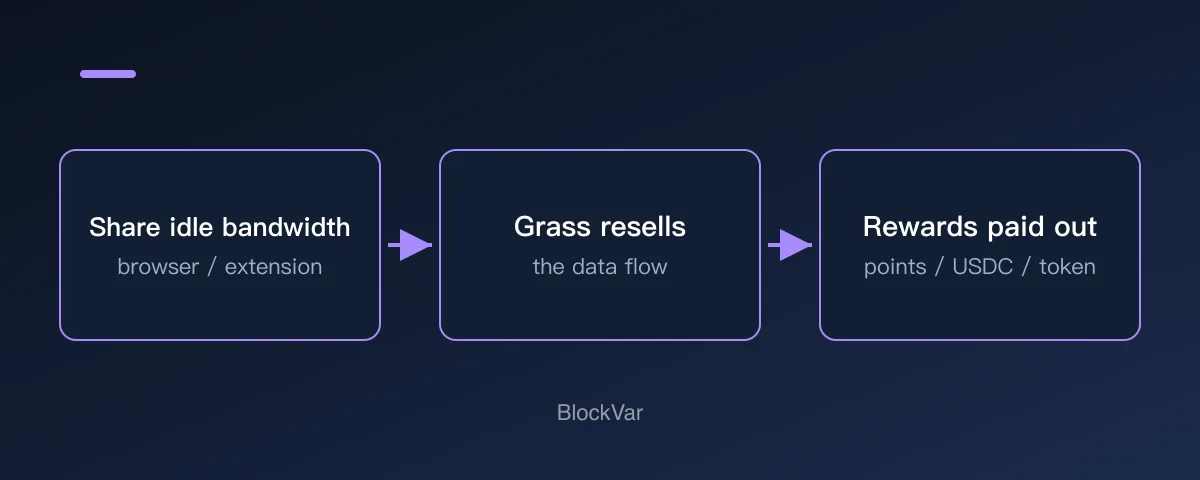
Diagram: the Grass value chain — users contribute bandwidth, the platform resells data, part of the revenue returns as rewards.
LCR: from training data to live AI retrieval
Grass announced its first Live Context Retrieval (LCR) products for this summer — turning its web-coverage map and crawling pipeline into a retrieval service that feeds running AI models with fresh context, rather than delivering batch training datasets.
Strategically, this matters more than the product name: batch data delivery is lumpy and cyclical, while retrieval billed per call or as an ongoing service produces more continuous revenue — moving Grass from "data vendor" toward "AI inference infrastructure." The real tests: latency, sustained data quality, and whether its collection and licensing practices withstand enterprise-grade compliance review.
Stage 2: rewards in USDC, and why that cuts both ways
Stage 2 covers Epochs 1–19 (October 14, 2024 – June 8, 2026). Rewards are paid entirely in USDC, funded from network revenue — no new GRASS issuance. Claims opened July 22, 2026, with a six-month window, through the Grass Dashboard and a new non-custodial wallet.
The design has clear merits: node operators receive low-volatility, directly priceable income, and the project avoids perpetual token inflation to pay contributors. It makes the loop — bandwidth contributed, clients pay, nodes get a share — look like a real business.
The controversy is equally direct: if contributors no longer earn GRASS, what generates ongoing demand for the token? Staking and governance narratives exist, but the market is waiting for concrete value capture. SolanaFloor reported the Stage 2 pool at just under $3M in USDC and documented long-time node operators complaining about low payouts; around the announcements, GRASS drew sharp price swings (third-party sources cite drops of roughly 23–33% depending on the measurement window — the expectation gap matters more than any single percentage).
The payout algorithm: online time no longer pays
The disclosed distribution rules weight uptime, connection quality, geography, referrals — and above all, data actually used by the network. Network Points convert at $0.0049 per point versus $0.00000007 for Uptime Points, with different multipliers for desktop and Android. The team also disclosed that about 150,000 users carried roughly 90% of Stage 2 network traffic.
This explains why "leaving a node running for months" did not equal high rewards: Grass now pays for bandwidth its customers actually consume, not for being online. As network economics, it is a rational upgrade; as communication, the weight change landed badly with users who understood accumulated uptime as a future-income promise. Every idle-node project faces this same transition — see the pattern across projects in our Project Watch coverage, including Gradient (which ended extension rewards entirely) and DAWN (still pre-token).
The native wallet: convenience and a new phishing surface
Stage 2 claiming runs through a new non-custodial wallet integrated with the Grass Dashboard. It lowers the claiming barrier for non-crypto-native users — and creates a fresh phishing surface: fake "Grass claim" pages will imitate the flow. Only enter through the official dashboard, and review how to spot fake claim sites before touching any airdrop link.
BlockVar's take: business value and token value are diverging
Grass increasingly resembles a functioning data company: real revenue, claimed profitability, product expansion into live retrieval, and rewards paid from income rather than inflation. That is genuinely rare in DePIN. But the same choices sharpen the token question — commercial success currently translates to USDC for contributors and uncertainty for GRASS holders. Watch these over the next two quarters:
- whether LCR ships on schedule and wins paying customers;
- whether any concrete GRASS value-capture mechanism (fee routing, staking utility, buybacks) is announced;
- whether payout-weight changes are communicated before, not after, they hit user earnings;
- whether the $65–75M revenue projection survives contact with reality.
FAQ
Is Grass still paying node rewards in 2026?
Yes — but Stage 2 rewards are paid in USDC, not GRASS, and payouts are weighted heavily toward bandwidth actually used by customers. Pure idle uptime earns very little under the current formula.
How do I claim Stage 2 rewards?
Through the official Grass Dashboard and its non-custodial wallet. Claims opened July 22, 2026, with a six-month window. Enter only via the official site — fake claim pages are guaranteed to appear.
Why did GRASS drop if the business is growing?
Because rewards switched to USDC and no new token value-capture mechanism was announced, the market questioned what links business revenue to token demand. That gap, plus payout disappointment, drove the sell-off.
Is running a Grass node still worth it?
Depends entirely on whether your bandwidth actually gets used — geography and connection quality decide that. Roughly 150,000 users carried ~90% of Stage 2 traffic; casual nodes earned little.
Related reading
- What Is Gradient Network? Sentry Node Rewards Have Ended
- What Is DAWN Network? Validator Points, Airdrop Odds, Risks
- How to Spot Fake Airdrop Claim Sites Before You Connect
References
Keep reading
Is There a MetaMask Airdrop? Rewards After Season 1 and the $MASK Question
MetaMask says there are no current plans for a $MASK token, and Rewards Season 1 has ended. What Rewards offers now and how to spot fake airdrops.

What Are Web3 Points? Do Points Turn Into Tokens?
Points are a project's own participation record; whether they convert, and into what, is the project's call. Examples from Grass, MetaMask Rewards and Abstract.
What Is a Sybil Address? How Airdrops Filter Them Out
Being flagged as a Sybil means a project decided many addresses belong to one person. How detection works, per the Arbitrum Foundation's published methodology.
What Are Layer3 Liquid Rewards? CUBE Mint Rebates and L3 Lock Tiers
Minting a CUBE on Layer3 can earn L3 back at up to 100%, in five tiers set by locked L3 or L3 plus a league. See the conditions, how to claim and why the rate is not a yield.
How to Earn Abstract XP: Weekly Updates, Badges and the XP Multiplier
According to Abstract's Portal docs, XP comes from using apps listed on the Discover page, streaming and building apps. It updates weekly and cannot be transferred. Learn how badges are earned, where the multiplier comes from and what can cost you XP.
Do Galxe Quest Rewards Cost Money? Claim Fees, Gas and GG Explained
According to Galxe, only quests with a claim fee can award GG. Learn the difference between the platform claim fee and network gas, which networks are supported, how Galxe+ and levels reduce fees, and what to weigh before paying.