



What Is Nodepay Now? From Bandwidth to the Signal Engine
Nodepay started as a bandwidth-sharing extension and has rewritten itself around the Signal Engine: turning community judgment, social momentum and on-chain data into market intelligence. What changed, what the NC token does now, and what to watch before participating.

Verified against official sources on July 12, 2026. Node and community figures come from project pages or public platform snapshots and do not directly equal active users, paying customers, or real revenue.
What is Nodepay? It is a community-driven real-time market intelligence network. It began as a browser-node network sharing idle bandwidth for AI data collection; its current core product is the Signal Engine, which processes user judgment, social momentum, and on-chain market data into usable signals.
If you met Nodepay early, you probably filed it as "another Grass": install an extension, contribute idle bandwidth, help AI companies collect public data, earn points. Open the current website and docs, though, and the subject of the sentence has changed. Bandwidth has not disappeared entirely, but the core narrative is now the Signal Engine: collecting human judgment, social discussion, news, and on-chain behavior, then refining them into real-time sentiment, narrative trends, and predictive signals. Source: Nodepay overview
That is not a redesign — it is a rewrite of the business.
What does Nodepay do now?
The product splits its inputs into three streams:
- Human judgment: users answer structured questions and express market expectations with confidence levels;
- Social signals: tracking topic velocity, influencer clusters, and narrative shifts on public platforms;
- Market and on-chain data: prices, news, and on-chain behavior layered against human sentiment.
Node Signals lets users submit question ideas, with the community voting on which signals deserve collection; creators of well-performing questions earn more. The team states it processes aggregated sentiment only, without tracking individual identity. Source: Node Signals docs
The target customers are not just AI labs but traders, analysts, project teams, and developers: users contribute judgment, the Signal Engine cleans the noise, customers buy faster market insight.
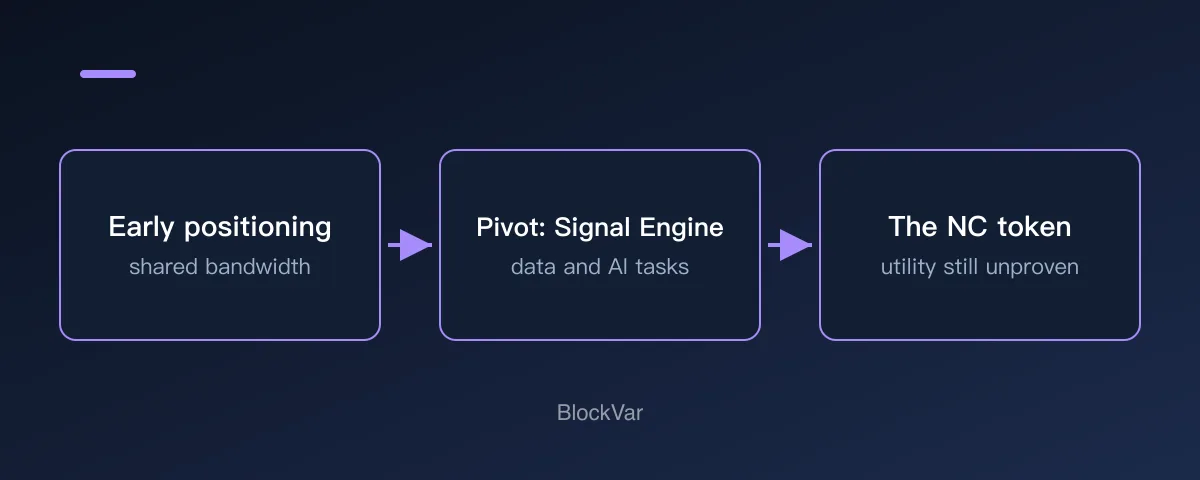
Diagram: Nodepay's repositioning — from selling bandwidth to data and AI tasks; NC's real utility depends on what ships next.
Why pivot away from bandwidth?
Pure bandwidth sharing has a structural problem: node supply grows easily, demand does not keep pace. Users expect rewards for merely staying online, but what has value is traffic actually used by customers. Grass's recent reward controversy demonstrated exactly this gap — see our Grass analysis.
Nodepay's new model asks participants for active work. Answering questions, creating signals, validating content, and amplifying quality insights map more directly to sellable data products than idling does. In theory, it reduces the mismatch of "millions of nodes waiting for a trickle of crawl tasks."
It also means Nodepay is no longer a pure bandwidth DePIN — it is closer to a prediction community and market-intelligence platform with token rewards. Success now depends on whether users keep contributing quality judgment and whether external customers pay for the output.
A big community is not the same as a good dataset
Nodepay's public Discord page shows roughly 303,000 members with over 11,000 online, and the server description claims more than 500,000 distributed nodes. Source: Nodepay Discord
Distribution is a real advantage — the same question reaches a large audience fast. The problem: points, tokens, and referral mechanics amplify low-quality participation. Account counts and answer volume do not automatically equal predictive accuracy.
What the Signal Engine actually needs is a verifiable reputation system: who is consistently right in which domains? Do users imitate each other? Can paid campaigns pollute results? How are bots and account farms filtered? These questions decide the product's value far more than community size.
Where the NC token fits
Official docs put Nodecoin (NC) at a fixed 1 billion supply with 208 million initial circulation, and 420 million allocated to community incentives — future contribution rewards, the first airdrop, and validator rewards. Source: Nodepay tokenomics
Current designed utility: earning NC for answering, creating, and amplifying signals; holding or paying NC for premium prediction, sentiment, and research tools; staking for validation, signal review, and future bandwidth-provider roles; governance, voting, and sponsored signals. The intended loop is contribute → earn → buy intelligence → value returns. Source: NC utility
Keep the documented utility separate from realized external revenue: a token can bootstrap community participation, but it cannot substitute for customer demand.
Nodepay vs Grass
Similarities: both depend on large networks of ordinary users, both convert distributed resources into AI-usable data, both distribute value through crypto incentives.
Differences: Grass focuses on residential bandwidth, public-web coverage, and data pipelines; Nodepay is moving toward human judgment, market sentiment, and distribution. Grass is closer to data infrastructure; Nodepay is closer to a real-time intelligence product.
The risks differ accordingly: Grass must prove the quality and compliance of crawled data; Nodepay must prove its crowd judgment is not noise manufactured by its own reward mechanics.
BlockVar's take
The pivot direction is defensible: passive bandwidth supply is easily oversupplied, while timely, quality-filtered human judgment remains scarce. But four things deserve tracking before treating it as more than a points platform:
- whether the Signal Engine publishes verifiable accuracy, latency, and anti-manipulation metrics;
- whether real external customers use the API or intelligence products;
- whether NC rewards favor judgment quality over clicks and shares;
- how much actual work bandwidth nodes still perform in the new architecture.
With data answering those questions, Nodepay could graduate from points-DePIN to a genuine crowd-intelligence network; without transparent customers and accuracy, it has merely swapped idle farming for engagement tasks.
FAQ
Can I still earn with Nodepay by sharing bandwidth?
Rewards now center on answering, creating, and amplifying signals rather than keeping a browser online. Bandwidth providers remain listed as a future staking/validation role — check current app rules for what actually pays.
How is Nodepay different from Grass?
Grass collects public web data through residential bandwidth; Nodepay now prioritizes human judgment and market sentiment. Both rely on large communities, but they sell different data products.
What is the NC token used for?
Documented uses: contribution rewards, premium tool access, staking for validation roles, and governance. Distinguish documented utility from realized demand — check what external customers actually pay for.
Related reading
- Grass in 2026: Revenue Up, USDC Rewards, Token Debate
- What Is Gradient Network? Sentry Node Rewards Have Ended
- What Is DAWN Network? Validator Points, Airdrop Odds, Risks
References
Keep reading
Is There a MetaMask Airdrop? Rewards After Season 1 and the $MASK Question
MetaMask says there are no current plans for a $MASK token, and Rewards Season 1 has ended. What Rewards offers now and how to spot fake airdrops.

What Are Web3 Points? Do Points Turn Into Tokens?
Points are a project's own participation record; whether they convert, and into what, is the project's call. Examples from Grass, MetaMask Rewards and Abstract.
What Is a Sybil Address? How Airdrops Filter Them Out
Being flagged as a Sybil means a project decided many addresses belong to one person. How detection works, per the Arbitrum Foundation's published methodology.
What Are Layer3 Liquid Rewards? CUBE Mint Rebates and L3 Lock Tiers
Minting a CUBE on Layer3 can earn L3 back at up to 100%, in five tiers set by locked L3 or L3 plus a league. See the conditions, how to claim and why the rate is not a yield.
How to Earn Abstract XP: Weekly Updates, Badges and the XP Multiplier
According to Abstract's Portal docs, XP comes from using apps listed on the Discover page, streaming and building apps. It updates weekly and cannot be transferred. Learn how badges are earned, where the multiplier comes from and what can cost you XP.
Do Galxe Quest Rewards Cost Money? Claim Fees, Gas and GG Explained
According to Galxe, only quests with a claim fee can award GG. Learn the difference between the platform claim fee and network gas, which networks are supported, how Galxe+ and levels reduce fees, and what to weigh before paying.