



What Is Bless Network? 5M Nodes and the Shared Computer
Bless Network wants to organize idle CPUs, GPUs and bandwidth from everyday devices into one shared computer. We examine the 5-million-node claim, how uptime points work today, the planned BLESS token utility per its MiCA whitepaper, and what still needs proving.

Verified against official sources on July 12, 2026. Network-scale figures are Bless's own reporting and do not imply all nodes are simultaneously online, equally capable, or already serving paid workloads.
What is Bless Network? It is a decentralized edge-computing network that aims to organize the idle CPU, GPU, and bandwidth of ordinary computers, phones, and browser nodes into an on-demand "shared computer." Node operators contribute resources and accumulate rewards; developers deploy AI, web services, and other compute tasks across the network.
Where Grass asks users to contribute idle bandwidth, Bless goes further: it wants laptops, desktops, phones, and tablets to form one global machine. Users install a browser extension or desktop tool, devices pick up tasks while idle, and developers consume the distributed compute. The site currently claims more than 5 million user-maintained nodes across compute, AI, gaming, research, and consumer-earnings verticals. Source: Bless website
That number attracts attention — but what Bless actually has to prove is not how many devices signed up. It is how much stable, customer-paid work those heterogeneous devices can complete.
How the shared computer works
The entry path is light: install the extension or quick-launch app, allow the device to contribute idle resources, and the network matches tasks to device capability and user preference. No professional hardware required. Source: Bless node docs
The contrast with traditional GPU DePINs matters. Aethir and io.net lean toward data centers and high-end GPUs; Bless aggregates cheaper, more scattered, more variable edge devices. Those resources suit highly parallel, small-per-task, latency-sensitive work — some AI inference, data processing, web serving, multiplayer edge logic.
The difficulty comes from the same place: an old phone, a family laptop, and a professional GPU cannot be treated as one kind of compute. The network must evaluate hardware, uptime stability, connection quality, and verified task completion — otherwise "lots of nodes" only adds scheduling cost.
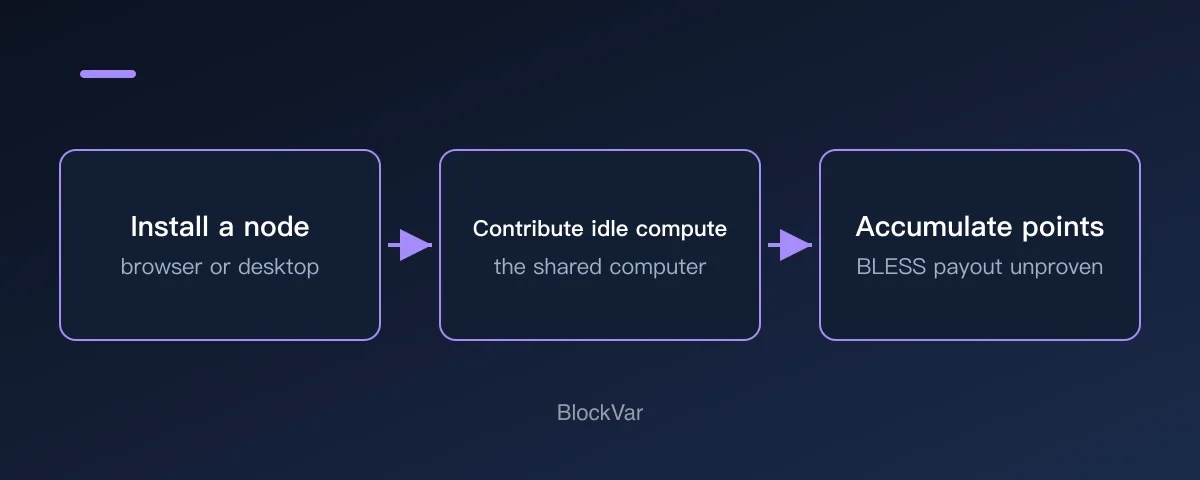
Diagram: the Bless participation loop — install, contribute idle compute, earn points; whether points convert depends on the team.
From uptime to real workload
Today, contribution is counted mainly by extension uptime; the team says actual completed compute tasks will enter the weighting later. The official FAQ is direct about it: uptime points accrue now, real workloads will matter later. Source: Bless FAQ
This is the same transition that generated Grass's reward controversy (our analysis): early projects recruit with the simplest possible metric — staying online — then commercialization forces payment for resources customers actually use. The transition period is where community conflict lives, because early users read accumulated uptime as a future-income promise while the network really needs a smaller set of stable, high-performance, schedulable nodes. Bless can avoid repeating that script only by explaining, in advance, how uptime points map to actual compute value.
The second bet: a consent-based behavioral data marketplace
Bless also lists a consent-based behavioral data marketplace: users opt in to contribute behavioral data for analytics, trend discovery, prediction, and AI training; declining means no collection. [Source: Bless website, Research]
That extends Bless from a compute network toward a data network — an intersection of Grass (edge-node data supply) and Vana (consent and user control) while also running compute on the same devices. The commercial upside is real, and so is the compliance bar: "user consent" cannot be a default checkbox. Collection scope, retention, buyer identity, revocation, and revenue sharing all need clarity, or the data business will erode trust in the node network.
October 2026 addendum: Bless's privacy policy answers several of these questions, and participants should know the answers. It states that the Bless data service may share or sell personal information to business partners and data purchasers for AI research, analytics, machine learning model development and other commercial purposes. Collected categories include email, IP address and device identifiers; browsing history, URLs visited, page titles, search history, and AI prompts and responses; and approximate location inferred from IP. It also discloses that identifiers and internet activity data were sold in the preceding 12 months. For users outside the EEA, UK, Switzerland and BVI, using the service counts as consent; you can withdraw by uninstalling the Bless Data extension or by emailing a request to delete your account and data. Source: Bless Privacy Policy
Read this alongside the website's statement that nothing is collected if you decline: the compute node and the data service are different things, so check the extension's name and data option when you install. For steps and precautions, see the Bless node participation guide.
Community scale, with the usual caveats
In a January 2025 recap, Bless disclosed 2M+ registered nodes, ~700K daily active, ~220K X followers, and ~205K Discord members; the site now says 5M+ nodes. Source: Bless recap
Strong acquisition, clearly. Still unanswered: how many nodes are online simultaneously, how many actually receive tasks, and how much external customers pay. In DePIN, supply-side growth is always the easy half.
What is the BLESS token for?
Per the project's MiCA whitepaper, current activity happens on an incentivized testnet, where users run extension nodes and accumulate uptime points. After mainnet, BLESS is planned for node staking, task rewards and settlement, and purchasing compute workloads. Source: Bless MiCA whitepaper
Whether that design works depends on tokens mapping to real tasks: customers pay for compute; the network settles with nodes on verifiable results; nodes stake to take orders; cheaters get slashed. If rewards flow mainly from reserved tokens rather than client revenue, the network stays subsidy-dependent. Only real external demand makes BLESS a settlement asset for a compute market.
BlockVar's take
Among browser-based idle projects, Bless feels closest to Grass in user experience — but its engineering problem is harder. Bandwidth is relatively standardizable; compute tasks depend on chips, memory, OS, thermals, and uptime all at once. Worth tracking:
- of the claimed 5M nodes, how many are monthly-active, concurrent, and schedulable;
- whether real workloads, customer cases, and task revenue get published;
- how uptime points migrate to task-quality-based compensation;
- whether the data marketplace ships granular consent, revocation, and auditability;
- whether mainnet and BLESS settlement land as the whitepaper describes.
Bless has proven it can organize supply at speed. The next stage is proving that this shared computer has actual users — not just millions of devices waiting for work.
FAQ
How do I run a Bless node?
Two official paths: the browser extension (lowest barrier) and the Native Node via Docker, which suits users offering stable resources and a controlled environment.
How are rewards calculated right now?
Mainly extension uptime plus activity boosts, accrued as uptime points on the incentivized testnet. The team says actual completed workloads will be weighted in later — do not read uptime points as a fixed future token income.
Is the BLESS token live?
Per the MiCA whitepaper (as of our July 12, 2026 verification), current activity is testnet points; BLESS utility — staking, settlement, workload purchase — is planned for after mainnet. Verify current status against official channels before acting on third-party claims.
Bless vs Grass — which should I run?
Different resources: Grass monetizes bandwidth for web data; Bless wants compute for distributed workloads. Grass currently pays USDC for used bandwidth; Bless is still in the points stage. Read both projects' current rules first.
Related reading
- Grass in 2026: Revenue Up, USDC Rewards, Token Debate
- What Is Nodepay Now? From Bandwidth to the Signal Engine
- What Is Gradient Network? Sentry Node Rewards Have Ended
References
Keep reading
Is There a MetaMask Airdrop? Rewards After Season 1 and the $MASK Question
MetaMask says there are no current plans for a $MASK token, and Rewards Season 1 has ended. What Rewards offers now and how to spot fake airdrops.

What Are Web3 Points? Do Points Turn Into Tokens?
Points are a project's own participation record; whether they convert, and into what, is the project's call. Examples from Grass, MetaMask Rewards and Abstract.
What Is a Sybil Address? How Airdrops Filter Them Out
Being flagged as a Sybil means a project decided many addresses belong to one person. How detection works, per the Arbitrum Foundation's published methodology.
What Are Layer3 Liquid Rewards? CUBE Mint Rebates and L3 Lock Tiers
Minting a CUBE on Layer3 can earn L3 back at up to 100%, in five tiers set by locked L3 or L3 plus a league. See the conditions, how to claim and why the rate is not a yield.
How to Earn Abstract XP: Weekly Updates, Badges and the XP Multiplier
According to Abstract's Portal docs, XP comes from using apps listed on the Discover page, streaming and building apps. It updates weekly and cannot be transferred. Learn how badges are earned, where the multiplier comes from and what can cost you XP.
Do Galxe Quest Rewards Cost Money? Claim Fees, Gas and GG Explained
According to Galxe, only quests with a claim fee can award GG. Learn the difference between the platform claim fee and network gas, which networks are supported, how Galxe+ and levels reduce fees, and what to weigh before paying.