


Idle DePIN Projects Compared: Who Still Pays, Who Stopped
One table across Grass, Nodepay, Bless, DAWN, Vana, Gradient and Pipe: how you participate, whether rewards still flow, token status, and what each network actually sells. Verified against official sources — because reward rules change faster than tutorials do.

Updated October 4, 2026: Grass and DAWN rewritten from their latest official information, and every other project re-checked, with dates noted per section. Based on official websites, documentation and whitepapers. Rules in this sector change fast — re-verify against official pages before committing time or money.
"Earn money while your computer idles" projects are the staple of passive-income crypto content. They share one trait the tutorials never mention: the rules change faster than the tutorials do. Some projects stopped issuing points while guides still teach the installation; some pivoted their entire business while guides still calculate rewards under the old formula.
This page compares every idle-node project our Project Watch category tracks, each entry based on officially verified facts, with a link to the full analysis.
The table
| Project | How you participate | Reward status | Token status | What it sells |
|---|---|---|---|---|
| Grass | Browser extension / desktop | Stage 2 ended — paid entirely in USDC, claims close January 22, 2027; how later participation is rewarded has not been announced | GRASS trading | AI training data, moving into live retrieval |
| Nodepay | Original bandwidth extension pivoted | Pivoted to Signal Engine crowd-prediction tasks | NC trading | Crowd intelligence / prediction data |
| Bless | Node extension / client | Active (incentivized-testnet uptime points; team says real workload weighting comes later) | BLESS planned for mainnet staking & settlement | Edge compute |
| DAWN | Validator browser extension | Pivoted to the USD.infra infrastructure vault; the extension page no longer mentions points or a token | No token mentioned on official pages | Digital-infrastructure financing (formerly community broadband) |
| Vana | Not idle-farming: data permissions / Personal Server | Data-contribution based, not uptime | VANA trading | Personal data sovereignty infrastructure |
| Gradient | Sentry Node extension | Ended: Season 1 closed August 28, 2025; extension earns nothing | No token; no TGE timeline | Distributed AI infrastructure (pivoted) |
| Pipe | Testnet PoP nodes → mainnet operation | Testnet farming closed; mainnet nodes earn for verified delivery | PIPE trading since Oct 2025 | Decentralized CDN → storage, compute, hosting and AI services |
The "reward status" column is the fastest-expiring column in this table — which is exactly the point: when you see any idle-farming tutorial, your first move is checking the official docs for whether rewards still exist.
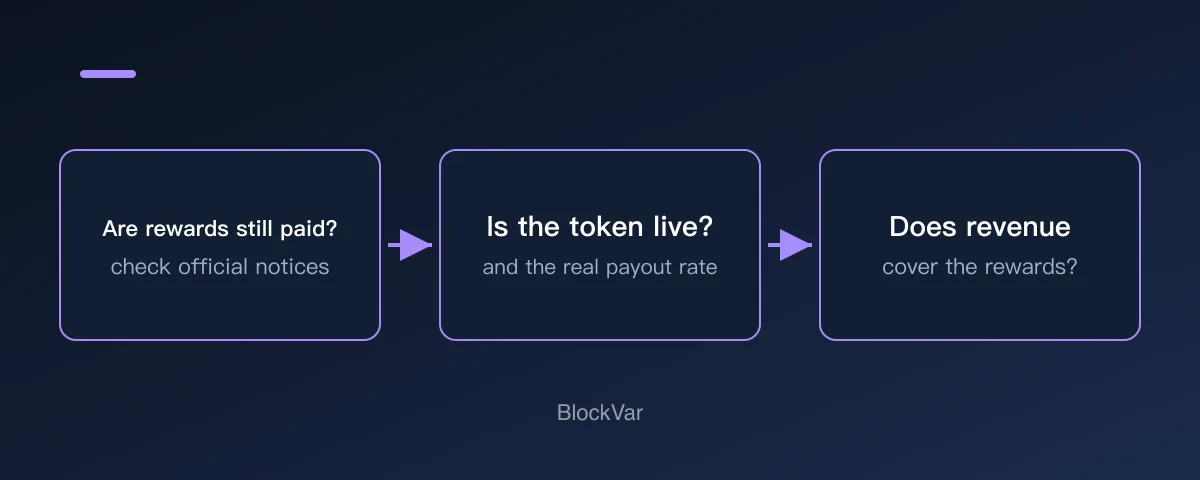
Diagram: the three filters used in this comparison — are rewards still flowing, is there a token with a real rate, and does revenue cover payouts.
Project by project
Grass: Stage 2 settled in USDC, next phase not announced
Grass monetizes idle residential bandwidth into AI data products and is the sector's commercial leader: disclosed H1 2026 revenue of $17M, claimed profitability, and an expansion into Live Context Retrieval. Stage 2 (October 14, 2024 to June 8, 2026) has ended and is paid entirely in USDC with no new GRASS issued; claims opened July 22, 2026 and close January 22, 2027. Conversion depends on point type: Network Points, earned when your bandwidth is actually used, are worth 0.0049 USDC each, about five orders of magnitude more than uptime points, and roughly 150,000 users carried about 90% of the traffic. How participation after June 8 will be rewarded has not been announced, and running Grass now does not count toward Stage 2. The controversy: business growth has not translated into GRASS token value capture. How to claim: Grass Stage 2 claim guide; background: Grass in 2026. (Verified 2026-10-03)
Nodepay: stop thinking "bandwidth sharing"
Nodepay was the other famous bandwidth extension; it has since rewritten itself around the Signal Engine — turning its community into a crowd-prediction network selling market intelligence. NC trades, the docs describe a contribute-earn-purchase loop, and the old bandwidth-farming guides simply no longer apply. Full analysis: What Is Nodepay Now? (Verified 2026-07-12; re-checked 2026-10-04: Signal Engine positioning and NC allocation unchanged)
Bless: five million nodes, still on incentivized testnet
Bless aggregates everyday devices into a "shared computer" for edge compute. It self-reports 5M+ nodes, but per its MiCA whitepaper, activity remains on the incentivized testnet accruing uptime points, with BLESS staking and settlement planned for mainnet. The team has said rewards will shift from uptime toward completed workloads. Full analysis: What Is Bless Network? (Verified 2026-07-12; re-checked 2026-10-04: the site still cites 5M+ nodes and uptime-based accrual)
DAWN: pivoted to infrastructure financing — stop treating it as a points project
DAWN set out to build community-owned broadband, and its Validator Extension was the points-farming entry point. In September 2026 DAWN launched the USD.infra vault (live September 22) and now leads its site with it, positioning itself as the capital layer for digital infrastructure: deposits fund network deployments under agreed contracts and are paid from them, the vault is open only to eligible non-US persons, and DAWN warns that participants can lose principal. The validator extension can still be downloaded, but the site now says it helps verify AI infrastructure financed by DAWN, and neither the announcement nor the extension page mentions points or a token. DAWN's earlier terms stated that points have no monetary value and may never convert. Full analysis: What Is DAWN Network? (Verified 2026-10-04)
Vana: not an idle project at all
Vana appears in this table because farming lists keep including it — incorrectly. It is a data-sovereignty protocol (Personal Servers, MCP permissions, portable AI memory); it wants your permission decisions, not your uptime, and VANA already trades. September 2026's Vega upgrade made data portability the network's primary function and splits data-read fees 60% to stakers, 20% to buyback-and-burn and 20% to ecosystem growth. Full analysis: What Is Vana? (Verified 2026-10-04)
Gradient: rewards ended — close the tutorials
Gradient's Sentry Node was a textbook extension-farming project until the official docs marked the Open Beta Concluded: Season 1 ended August 28, 2025, and the extension earns nothing now. The project pivoted to distributed AI infrastructure (Parallax is open-source) — worth watching, impossible to farm, no token. Full analysis: What Is Gradient Network? (Verified 2026-07-26; re-checked 2026-10-04: still concluded, no token or TGE announcement in the official docs)
Pipe: mainnet closed the farming window
Pipe Network ran the 2025 testnet farming era (about 290,000 PoP nodes), then launched mainnet in October 2025 with the PIPE token — ending points accumulation and moving node participation to verified-delivery economics, and the LovePIPE stake pool built with Jito went live in October 2025, letting holders stake PIPE to node operators. As of October 2026 the site leads with "Storage, compute, hosting & AI". Full analysis: What Is Pipe Network? (Verified 2026-10-04)
Choosing by goal
- You want a project with a payout record: Grass settled Stage 2 in USDC, but the next phase's rules are unannounced and running it now does not count toward Stage 2;
- You will bet time on a pre-token project: Bless still accrues uptime points on its incentivized testnet with no stated conversion; DAWN has pivoted to its vault, so stop treating it as a points project;
- You have real compute, not just bandwidth: Bless and Gradient's Edge Host program both point toward real-workload economics with higher bars than extensions;
- You see a Gradient or Pipe testnet farming guide: close it — those windows are over;
- Someone recommends "farming Vana": close that too; it is not an idle project.
Risks shared by all of them
- Points ≠ tokens: apart from Grass publishing USDC conversion rates after Stage 2 ended, none of these projects has committed in writing to a conversion ratio; DAWN's and Gradient's terms explicitly say points may be worth nothing;
- Rules change without notice: Grass settled in USDC, Nodepay pivoted, Gradient stopped, Pipe graduated, DAWN moved to a vault — all within little more than a year;
- Residential IP and privacy: extension projects route traffic through your home connection — read what the privacy policy allows (residential IP explainer);
- Multi-accounting bans: every project bans multi-boxing, VMs and proxy pools (why accounts get banned);
- Referral incentives distort advice: a tutorial author's referral income can exceed a year of your farming — earnings screenshots prove nothing;
- Fake claim pages: pre-token projects (DAWN) attract fake airdrop sites constantly — treat every "claim" page as phishing until officially announced (how to spot them).
FAQ
Which projects are still worth running in 2026?
As of October 4, 2026, only Bless still accrues points (on its incentivized testnet); Grass's Stage 2 has ended with the next phase unannounced, and DAWN has pivoted to its vault. Even where rewards exist, whether they are "worth it" depends on your electricity, IP quality, geography, and risk tolerance — treat potential payouts as lottery tickets, not wages.
Can I run several projects on one computer?
Technically most clients coexist, but each project judges multi-instance, proxy, and anomaly signals differently; stacking raises false-positive risk. Read each set of community guidelines first.
How current is this table?
Verification dates are noted per section. Major changes (a TGE announcement, a reward stoppage) get reflected in the individual project analyses first — treat those as the source of truth.
All project analyses
- Grass in 2026: Revenue Up, USDC Rewards, Token Debate
- What Is Nodepay Now? From Bandwidth to the Signal Engine
- What Is Bless Network? 5M Nodes and the Shared Computer
- What Is DAWN Network? USD.infra Vault, Validator Extension and Points Risks
- What Is Vana? Personal Servers and Portable AI Memory
- What Is Gradient Network? Sentry Node Rewards Have Ended
- What Is Pipe Network? Life After Mainnet and the PIPE Token
Related reading
- Your Node Points Went to Zero. Now What?
- Is idle node farming worth it? An honest calculation
- Why do node accounts get banned? The rules nobody reads
References
- Gradient docs: Sentry Node Open Beta (Concluded)
- Bless MiCA whitepaper
- Nodepay docs: NC utility
- DAWN: USD.infra vault announcement
- Vana: Vega upgrade staking and tokenomics
- Jito Foundation: LovePIPE
- Grass: Stage 2 rewards allocation
- Pipe Network mainnet announcement
- Additional sources are listed in each individual project analysis.